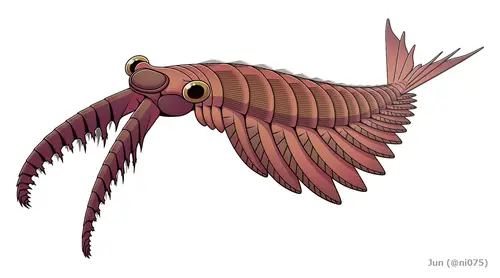
 🎨 Restoration
Restoration: Junnn11 · CC BY-SA 4.0 · Wikimedia Commons Source
Life restorations are artistic reconstructions based on fossil evidence; true coloration and soft-tissue details remain uncertain.
Anomalocaris
Anomalocaris canadensis (Anomalocaris · Anomalocaris)
Known only from fossils. The IUCN Red List assesses only species extant since 1500 CE, so fossil taxa are not assigned a category.
💡 Everyday Comparisons for Size, Mass & Speed
- 💡 Its maximum estimated length of about 100 cm is the length of a 1 m school ruler, while the most complete fossil at 25 cm is shorter than a 30 cm ruler (Comparison).
- 💡 The first described specimen was just a single frontal appendage, and its appearance was reconstructed more accurately after multiple complete specimens were found during Royal Ontario Museum excavations in the early 1990s.
Reference standards: coach bus ~12 m, mid-size car ~4.9 m, compact car ~1 t, basketball hoop 3.05 m, credit card 8.56 cm.
📖 1. Overview
Anomalocaris canadensis is a representative radiodont animal that lived in Cambrian seas about 505 million years ago and is found in the Burgess Shale of Canada. The Royal Ontario Museum describes it as the most iconic member of its group.
🦴 2. Anatomy & Morphology
Its body is dorsoventrally flattened with 16 pairs of swimming flaps along the sides and a tail fan. Its head bears a pair of spiny frontal appendages, a pair of large stalked eyes, and a mouth with teeth arranged in a ring.
🔍 3. Fossil Record & Paleoecology
It swam by undulating its streamlined body and lateral flaps, using its tail fan to turn quickly in pursuit of fast prey. Its large eyes, spiny frontal appendages, and mouth structure support the interpretation that it was a predator.
🇰🇷 4. Connection to Korea
No direct record connecting this species to Korea has been found.
📚 Sources & References
- • Fossil taxon — the IUCN Red List assesses only species living or extinct since 1500
- • paleobiodb.org — basicTaxonInfo
- • wikidata.org — Q21237616
- • commons.wikimedia.org — File:Anomalocaris canadensis grasping claw, Burgess Shale.jp
- • burgess-shale.rom.on.ca — anomalocaris-canadensis
- • Silhouette: PhyloPic — Amy Beauvois · CC0 1.0
Recorded dimensions are widely cited representative estimates from public literature and may vary by study or specimen.