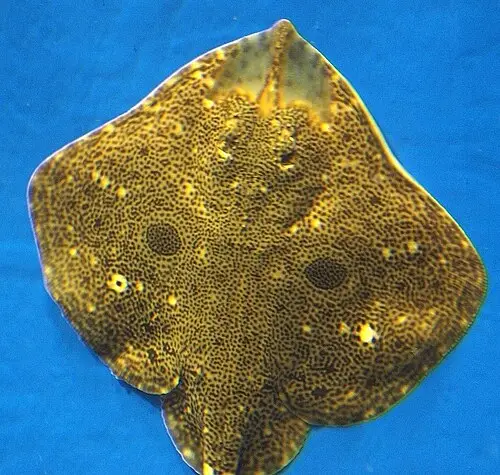
 📸 Photo
Photo: OpenCage.info · CC BY-SA 2.5 · Wikimedia Commons Source
Ocellate spot skate
Okamejei kenojei (Ocellate spot skate · コモンカスベ)
💡 Everyday Comparisons for Size, Mass & Speed
- 💡 Its maximum weight of 815.7 g is about the weight of sixteen eggs (Comparison, counting 1 egg as about 50 g).
- 💡 Its egg capsule length of 4.8–6.6 cm is similar in size to a matchbox (about 5 cm) (Comparison).
- 💡 It is used for food, and large ones are sometimes fermented until they smell of ammonia before being eaten (National List of Species of Korea).
Reference standards: coach bus ~12 m, mid-size car ~4.9 m, compact car ~1 t, basketball hoop 3.05 m, credit card 8.56 cm.
Site-computed relative index from recorded values; not a formal scientific metric.
📖 1. Overview
The ocellate spot skate (Okamejei kenojei) is a bottom-dwelling fish with a horizontally broad, diamond-shaped body living along the coasts of the West Sea, South Sea, Jeju Island, and East Sea of Korea. Large individuals are also eaten fermented.
🦴 2. Anatomy & Morphology
Its body is diamond-shaped like a stingray but rounder and wider from side to side. Its snout is relatively short, and round blotches containing dark brown spots at the base of the pectoral fins distinguish it from related species.
🔍 3. Ecology & Behavior
It feeds on invertebrates and fish on the bottom. It mates for internal fertilization and is oviparous, spawning 4–5 eggs at a time from late autumn to early spring. Its egg capsules are encased in a keratinous shell with corner horns that tangle in seaweed.
🇰🇷 4. Connection to Korea
It is listed on the National List of Species of Korea as inhabiting the West Sea, South Sea, Jeju Island, and East Sea. Large individuals are introduced as being fermented until they give off an ammonia scent before eating.
📚 Sources & References
- • IUCN Red List VU (2021) — https://www.iucnredlist.org/species/161645/124520681
- • IUCN Red List category VU — latest assessment at iucnredlist.org
- • catalogueoflife.org — KVLVL
- • iucnredlist.org — 124520681
- • 국가생물종목록(국립생물자원관) ktsn 120000057362 — https://species.nibr.go.kr/home/mainHome.do?cont_link=009&subMenu=009002&contCd=009002&ktsn=120000057362
- • wikidata.org — Q839258
- • commons.wikimedia.org — File:Okamejei kenojei2.jpg
- • fishbase.se — Okamejei-kenojei.html
- • species.nibr.go.kr — mainHome.do
- • Silhouette: PhyloPic — author not recorded · CC0 1.0 (Related taxon silhouette — Amblyraja radiata)
Recorded dimensions are widely cited representative estimates from public literature and may vary by study or specimen.