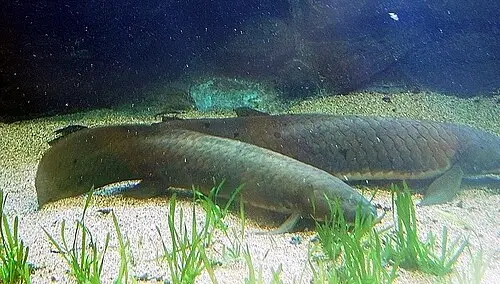
 📸 Photo
Photo: Unknown author Unknown author · CC BY-SA 2.5 · Wikimedia Commons Source
Australian lungfish
Neoceratodus forsteri (Australian lungfish · オーストラリアハイギョ)
💡 Everyday Comparisons for Size, Mass & Speed
- 💡 Its maximum length of 1.5 m is about the height of a tall adult, and 40 kg is similar to the weight of two 20 kg bags of rice (Comparison).
- 💡 The Australian Museum reports that an individual of this species named 'Granddad' lived for over 80 years at the Shedd Aquarium in Chicago, USA.
- 💡 In Australia, it is protected by law and cannot be caught without a permit.
Reference standards: coach bus ~12 m, mid-size car ~4.9 m, compact car ~1 t, basketball hoop 3.05 m, credit card 8.56 cm.
Site-computed relative index from recorded values; not a formal scientific metric.
📖 1. Overview
The Australian lungfish is a large freshwater fish around 1.5 m long living natively in only two rivers in southeastern Queensland, Australia, capable of breathing with both gills and a lung.
🦴 2. Anatomy & Morphology
Its body is stout and elongated, covered with large overlapping bony scales, and its pectoral and pelvic fins are shaped like flattened flippers. It normally breathes with its gills, but when water quality worsens it can gulp air at the surface using its single lung.
🔍 3. Ecology & Behavior
Active at night, it feeds mainly on frogs, tadpoles, small fish, snails, shrimp, and earthworms, along with a small amount of plant matter. It grows very slowly, reaching 12 cm after 2 years.
🇰🇷 4. Connection to Korea
No direct record connecting this species to Korea has been found.
📚 Sources & References
- • IUCN Red List EN (2019) — https://www.iucnredlist.org/species/122899816/123382021
- • IUCN Red List category EN — latest assessment at iucnredlist.org
- • catalogueoflife.org — 6S8FM
- • iucnredlist.org — 123382021
- • wikidata.org — Q782345
- • commons.wikimedia.org — File:Queensland Lungfish (Neoceratodus forsteri).jpg
- • australian.museum — australian-lungfish-neoceratodus-forsteri-krefft-1870
- • fishbase.se — Neoceratodus-forsteri.html
- • Silhouette: PhyloPic — Roberto Díaz Sibaja · CC BY 3.0
Recorded dimensions are widely cited representative estimates from public literature and may vary by study or specimen.