 📸 Photo
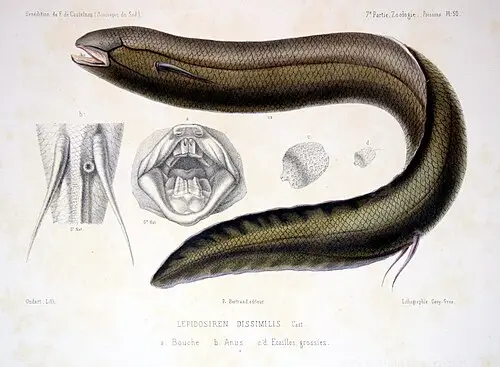
Photo: François-Louis Laporte, comte de Castelnau · Public domain · Wikimedia Commons Source
South American lungfish
Lepidosiren paradoxa (South American lungfish · ミナミアメリカハイギョ)
💡 Everyday Comparisons for Size, Mass & Speed
- 💡 Its maximum length of 125 cm is similar to the height of a lower-grade elementary school child (about 1.2 m) (Comparison).
- 💡 According to ADW, it provides no direct economic benefit, but lungfish are important research and educational resources showing how vertebrates moved from water onto land.
Reference standards: coach bus ~12 m, mid-size car ~4.9 m, compact car ~1 t, basketball hoop 3.05 m, credit card 8.56 cm.
📖 1. Overview
The South American lungfish is a lungfish living mainly in the Amazon River basin, staying near the surface of stagnant swamps and lakes. As it grows, it comes to rely solely on air breathing.
🦴 2. Anatomy & Morphology
Its body is long and slender like a salamander, and it has solid tooth plates instead of individual teeth. Juveniles have yellow spots that fade as they grow, and adults turn black or gray.
🔍 3. Ecology & Behavior
It feeds on fish, shrimp, insects, clams, snails, algae, and plant stems, while juveniles eat insect larvae and snails. During droughts, it burrows up to 50 cm into the mud to avoid drying out, and builds nests during the rainy months.
🇰🇷 4. Connection to Korea
No direct record connecting this species to Korea has been found.
📚 Sources & References
- • IUCN Red List LC (2022) — https://www.iucnredlist.org/species/49830702/159889457
- • IUCN Red List category LC — latest assessment at iucnredlist.org
- • catalogueoflife.org — 6PBWM
- • iucnredlist.org — 159889457
- • wikidata.org — Q1410142
- • commons.wikimedia.org — File:F de Castelnau-poissonsPl50.jpg
- • animaldiversity.org — Lepidosiren paradoxa
- • fishbase.se — Lepidosiren-paradoxa.html
- • Silhouette: PhyloPic — Roberto Díaz Sibaja · CC BY 3.0
Recorded dimensions are widely cited representative estimates from public literature and may vary by study or specimen.