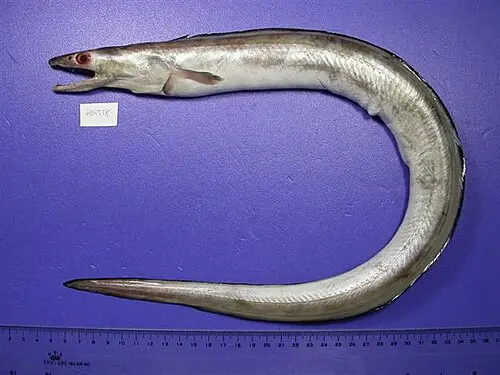
 📸 Photo
Photo: James Lin · CC BY 3.0 · Wikimedia Commons Source
Daggertooth pike conger
Muraenesox cinereus (Daggertooth pike conger · ハモ)
💡 Everyday Comparisons for Size, Mass & Speed
- 💡 Its maximum total length of 2.2 m is slightly longer than the height of a room door (about 2 m) (Comparison).
- 💡 Because its bones are stiff, the flesh is filleted for raw fish dishes or shabu-shabu, and in Yeosu it is also called 'chamjangeo' (a Korean local name) (National List of Species of Korea).
- 💡 In Japan, it is a target of commercial fisheries and aquaculture (FishBase).
Reference standards: coach bus ~12 m, mid-size car ~4.9 m, compact car ~1 t, basketball hoop 3.05 m, credit card 8.56 cm.
📖 1. Overview
The daggertooth pike conger is a marine eel with a long cylindrical body and very sharp teeth, widely distributed from the Indian Ocean to the western Pacific.
🦴 2. Anatomy & Morphology
Its back is dark brown and its belly is white. Its teeth are very sharp, and its body is cylindrical like that of the whitespotted conger.
🔍 3. Ecology & Behavior
It is active at night, feeding on small bottom-dwelling fish, crustaceans, and invertebrates. It spawns in June–July, and the willow-leaf-shaped larvae that hatch from the eggs undergo metamorphosis.
🇰🇷 4. Connection to Korea
It is listed on the National List of Species of Korea and lives in the West Sea, South Sea, Jeju Island, and southern East Sea. It is caught mainly from May to November.
📚 Sources & References
- • IUCN Red List LC (2021) — https://www.iucnredlist.org/species/199344/2585390
- • IUCN Red List category LC — latest assessment at iucnredlist.org
- • catalogueoflife.org — 44L7T
- • iucnredlist.org — 2585390
- • 국가생물종목록(국립생물자원관) ktsn 120000057450 — https://species.nibr.go.kr/home/mainHome.do?cont_link=009&subMenu=009002&contCd=009002&ktsn=120000057450
- • wikidata.org — Q1151328
- • commons.wikimedia.org — File:Muraenesox cinereus.JPG
- • fishbase.se — Muraenesox-cinereus.html
- • species.nibr.go.kr — mainHome.do
Recorded dimensions are widely cited representative estimates from public literature and may vary by study or specimen.