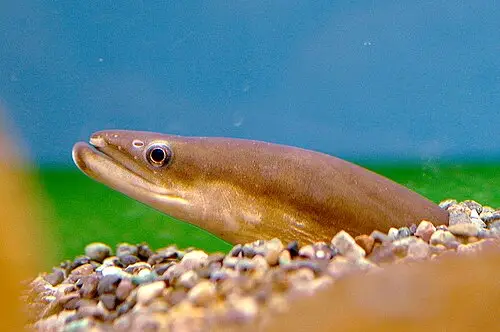
 📸 Photo
Photo: opencage · CC BY-SA 2.5 · Wikimedia Commons Source
Japanese eel
Anguilla japonica (Japanese eel · ニホンウナギ)
💡 Everyday Comparisons for Size, Mass & Speed
- 💡 A maximum total length of 150 cm is one and a half 1 m rulers long (comparison).
- 💡 Ranked as the most expensive food fish in Japan (FishBase), it is eaten steamed, broiled, or baked and is also used fresh, smoked, canned, or frozen.
- 💡 In Korea, it can be seen in rivers nationwide except parts of the East Sea coast (Korea's National Species List).
- 💡 It is also used in traditional herbal medicine (FishBase).
Reference standards: coach bus ~12 m, mid-size car ~4.9 m, compact car ~1 t, basketball hoop 3.05 m, credit card 8.56 cm.
Site-computed relative index from recorded values; not a formal scientific metric.
📖 1. Overview
The Japanese eel is a fish that grows in freshwater and migrates out to sea to spawn, occurring in Korea, Japan, China, Taiwan, and Vietnam. The International Union for Conservation of Nature (IUCN) assesses it as Endangered (EN, 2020).
🦴 2. Anatomy & Morphology
The body is slender and elongated, with tiny scales embedded in the skin. The lower jaw protrudes beyond the upper jaw, pelvic fins are absent, and the dorsal, anal, and caudal fins are joined into one.
🔍 3. Ecology & Behavior
It eats all kinds of aquatic animals—including shrimp, crabs, aquatic insects, and small fishes—hiding by day and active mainly at night. Its spawning ground is presumed to be in waters near the western Mariana Islands, and young eels ascend rivers in schools to grow in freshwater.
🇰🇷 4. Connection to Korea
It is listed on Korea's National Species List and occurs in rivers across the country except those flowing into the East Sea coast north of the Osipcheon Stream in Samcheok.
📚 Sources & References
- • IUCN Red List EN (2020) — https://www.iucnredlist.org/species/166184/176493270
- • IUCN Red List category EN — latest assessment at iucnredlist.org
- • catalogueoflife.org — 66R7C
- • iucnredlist.org — 176493270
- • 국가생물종목록(국립생물자원관) ktsn 120000057414 — https://species.nibr.go.kr/home/mainHome.do?cont_link=009&subMenu=009002&contCd=009002&ktsn=120000057414
- • wikidata.org — Q1140081
- • commons.wikimedia.org — File:Anguilla japonica.jpg
- • fishbase.se — Anguilla-japonica.html
- • species.nibr.go.kr — mainHome.do
- • Silhouette: PhyloPic — Steven Traver · CC0 1.0 (Congeneric silhouette — Anguilla rostrata)
Recorded dimensions are widely cited representative estimates from public literature and may vary by study or specimen.