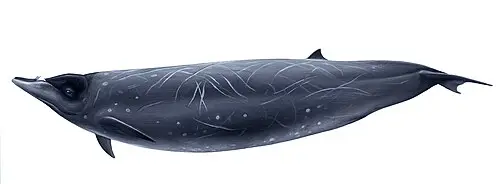
 📸 Photo
Photo: Jörg Mazur · CC BY-SA 4.0 · Wikimedia Commons Source
Stejneger's Beaked Whale
Mesoplodon stejnegeri (Stejneger's Beaked Whale · オウギハクジラ)
💡 Everyday Comparisons for Size, Mass & Speed
- 💡 Its maximum weight of about 1.6 tonnes is similar to a passenger car (about 1.5 tonnes) (Comparison).
- 💡 In Japan, small numbers are taken commercially each year, and some become entangled in salmon drift gillnets.
Reference standards: coach bus ~12 m, mid-size car ~4.9 m, compact car ~1 t, basketball hoop 3.05 m, credit card 8.56 cm.
Site-computed relative index from recorded values; not a formal scientific metric.
📖 1. Overview
Stejneger's Beaked Whale is a beaked whale living in the deep waters of the North Pacific, with tusk-like teeth protruding from the lower jaw in males.
🦴 2. Anatomy & Morphology
It has a rounded, medium-sized body ranging from gray to black in color. Males have a pair of large, forward-tilted flat teeth exposed near the middle of the lower jaw, and fighting scars are common on their bodies.
🔍 3. Ecology & Behavior
It mainly eats deep-sea squid and also sucks in small fish and tunicates. It travels in small groups of 5–15 individuals, making a series of short dives followed by a long dive of 10–15 minutes.
🇰🇷 4. Connection to Korea
It is listed as Keun-ippal-burigorae (Korean name) on the National List of Species of Korea, and may occur throughout Korean waters.
📚 Sources & References
- • IUCN Red List NT (2020) — https://www.iucnredlist.org/species/13252/50367496
- • IUCN Red List category NT — latest assessment at iucnredlist.org
- • mammaldiversity.org — 1006482
- • iucnredlist.org — 50367496
- • 국가생물종목록(국립생물자원관) ktsn 120000053423 — https://species.nibr.go.kr/home/mainHome.do?cont_link=009&subMenu=009002&contCd=009002&ktsn=120000053423
- • wikidata.org — Q1125029
- • commons.wikimedia.org — File:Mesoplodon stejnegeri.jpg
- • fisheries.noaa.gov — stejnegers-beaked-whale
- • animaldiversity.org — Mesoplodon stejnegeri
- • species.nibr.go.kr — mainHome.do
- • Silhouette: PhyloPic — author not recorded · CC0 1.0 (Congeneric silhouette — Mesoplodon mirus)
Recorded dimensions are widely cited representative estimates from public literature and may vary by study or specimen.