 📸 Photo
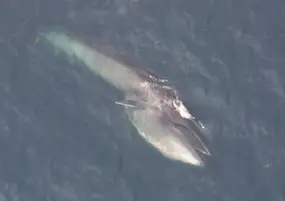
Photo: NOAA, Right Wale Aerial Survey · Public domain · Wikimedia Commons Source
Sei Whale
Balaenoptera borealis (Sei Whale · イワシクジラ)
🇰🇷 Marine Protected Species (Korea)
💡 Everyday Comparisons for Size, Mass & Speed
- 💡 Its speed of about 55 km/h is faster than a typical urban road speed limit (50 km/h) (Comparison).
- 💡 Its body length of 18.3 m is about one and a half large city buses (about 12 m) (Comparison).
Reference standards: coach bus ~12 m, mid-size car ~4.9 m, compact car ~1 t, basketball hoop 3.05 m, credit card 8.56 cm.
Site-computed relative index from recorded values; not a formal scientific metric.
📖 1. Overview
The sei whale is a fast-swimming baleen whale living in offshore waters around the world from subtropical to subpolar regions.
🦴 2. Anatomy & Morphology
Its body is dark bluish gray to black with a white or cream belly, and its tall dorsal fin curves like a hook. It has 219–410 baleen plates and 30–65 throat pleats.
🔍 3. Ecology & Behavior
At dusk and dawn it gulps water or skims the surface to feed on plankton (copepods and krill), small schooling fish, and squid, consuming about 2,000 pounds (about 900 kg) a day. It travels alone or in pods of two or three to five, and females give birth once every 2–3 years.
🇰🇷 4. Connection to Korea
It is a species recorded in Korean waters and listed under the Korean name Bori-gorae in the National List of Species of Korea (National Institute of Biological Resources (NIBR)).
📚 Sources & References
- • IUCN Red List EN (2018) — https://www.iucnredlist.org/species/2475/130482064
- • 해양보호생물 — 국가생물종목록(국립생물자원관) ktsn 120000053364 — https://species.nibr.go.kr/home/mainHome.do?cont_link=009&subMenu=009002&contCd=009002&ktsn=120000053364
- • IUCN Red List category EN — latest assessment at iucnredlist.org
- • Korean protection status: Marine Protected Species (Korea)
- • mammaldiversity.org — 1006399
- • iucnredlist.org — 130482064
- • 국가생물종목록(국립생물자원관) ktsn 120000053364 — https://species.nibr.go.kr/home/mainHome.do?cont_link=009&subMenu=009002&contCd=009002&ktsn=120000053364
- • wikidata.org — Q185097
- • commons.wikimedia.org — File:Balaenoptera borealis 3.jpg
- • fisheries.noaa.gov — sei-whale
- • species.nibr.go.kr — general-search
- • Silhouette: PhyloPic — author not recorded · Public Domain Mark 1.0 (Congeneric silhouette — Balaenoptera robusta)
Recorded dimensions are widely cited representative estimates from public literature and may vary by study or specimen.