 📸 Photo
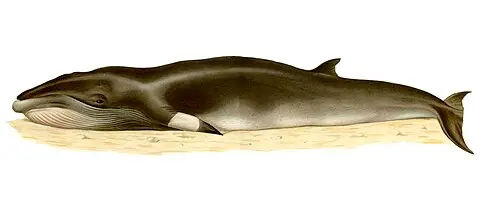
Photo: Marie Firmin Bocourt · Public domain · Wikimedia Commons Source
Common Minke Whale
Balaenoptera acutorostrata (Common Minke Whale · ミンククジラ)
💡 Everyday Comparisons for Size, Mass & Speed
- 💡 Its body length of 10.7 m is similar to the length of a large city bus (Comparison).
- 💡 Its weight of about 9 tons equals roughly six passenger cars (about 1.5 tons each) (Comparison).
Reference standards: coach bus ~12 m, mid-size car ~4.9 m, compact car ~1 t, basketball hoop 3.05 m, credit card 8.56 cm.
Site-computed relative index from recorded values; not a formal scientific metric.
📖 1. Overview
The common minke whale is one of the smaller baleen whales, living in coastal and offshore waters and migrating between the Arctic ice edge in summer and near the equator in winter.
🦴 2. Anatomy & Morphology
It has a tall, sickle-shaped dorsal fin, a pale chevron mark behind the head, and a white band on each flipper. Each side of the mouth holds 230–360 short white baleen plates, and the throat has 50–70 pleats.
🔍 3. Ecology & Behavior
Lunging sideways to gulp large amounts of water, it feeds on crustaceans and small schooling fish such as herring, mackerel, cod, and sand lance. It usually travels alone or in groups of two or three, diving for about 6–12 minutes at a time.
🇰🇷 4. Connection to Korea
It is a species recorded in Korean waters and listed under the Korean name Mingkeu-gorae in the National List of Species of Korea (National Institute of Biological Resources (NIBR)).
📚 Sources & References
- • IUCN Red List LC (2018) — https://www.iucnredlist.org/species/2474/50348265
- • IUCN Red List category LC — latest assessment at iucnredlist.org
- • mammaldiversity.org — 1006397
- • iucnredlist.org — 50348265
- • 국가생물종목록(국립생물자원관) ktsn 120000053363 — https://species.nibr.go.kr/home/mainHome.do?cont_link=009&subMenu=009002&contCd=009002&ktsn=120000053363
- • wikidata.org — Q201808
- • commons.wikimedia.org — File:Balaenoptera-acutorostrata.jpg
- • fisheries.noaa.gov — minke-whale
- • species.nibr.go.kr — general-search
- • Silhouette: PhyloPic — author not recorded · CC0 1.0
Recorded dimensions are widely cited representative estimates from public literature and may vary by study or specimen.