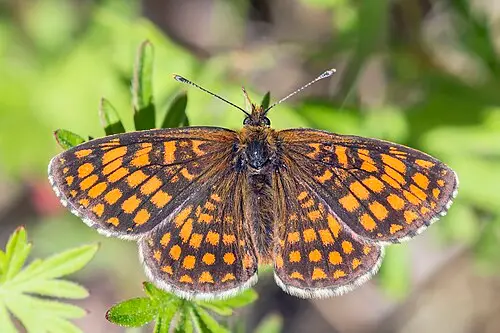
 📸 Photo
Photo: Charles J. Sharp · CC BY-SA 4.0 · Wikimedia Commons Source
Heath fritillary
Mellicta athalia (Heath fritillary · Heath fritillary)
Not Evaluated (NE) on the IUCN Red List yet.
🇰🇷 Class II endangered wildlife (Korea)
💡 Everyday Comparisons for Size, Mass & Speed
- 💡 A wingspan of 42 mm is slightly smaller than two Korean 100-won coins (24 mm in diameter) side by side (48 mm) (Comparison).
- 💡 The National Institute of Ecology notes that it sips nectar from common wildflowers such as daisy fleabane and thistle, and that its population is declining due to grassland loss and climate change.
Reference standards: coach bus ~12 m, mid-size car ~4.9 m, compact car ~1 t, basketball hoop 3.05 m, credit card 8.56 cm.
📖 1. Overview
The heath fritillary is a brush-footed butterfly (family Nymphalidae) designated as a Class II endangered wildlife species in Korea; it was common across the inland Korean Peninsula until the 1990s but has recently declined sharply.
🦴 2. Anatomy & Morphology
Its wingspan is 34–42 mm. The upper side has a net-like black band pattern on a reddish-brown background, and females have larger wings and a paler ground color than males. It is brighter in color and larger than Bomeori-pyobeom-nabi (a Korean butterfly name).
🔍 3. Ecology & Behavior
It occurs once a year, with adults appearing in June–July, and overwinters as a larva. Flying low over grasslands, it sips nectar from flowers of daisy fleabane, thistle, Veronicastrum sibiricum, and Lysimachia clethroides, and females lay eggs on the underside of Artemisia japonica leaves. It is declining due to climate change and grassland loss.
🇰🇷 4. Connection to Korea
It is a Class II endangered wildlife species (Korea). Until recently it was confirmed in parts of Jeolla-do and Gangwon-do, but it is currently no longer confirmed in Gangwon-do.
📚 Sources & References
- • 멸종위기 야생생물 Ⅱ급 — 국가생물종목록(국립생물자원관) ktsn 120000035809 — https://species.nibr.go.kr/home/mainHome.do?cont_link=009&subMenu=009002&contCd=009002&ktsn=120000035809
- • IUCN Red List: not evaluated (NE) — cross-checked with the Wikidata conservation-status entry
- • Korean protection status: Class II endangered wildlife (Korea)
- • catalogueoflife.org — 3ZL64
- • 국가생물종목록(국립생물자원관) ktsn 120000035809 — https://species.nibr.go.kr/home/mainHome.do?cont_link=009&subMenu=009002&contCd=009002&ktsn=120000035809
- • wikidata.org — Q15796566
- • commons.wikimedia.org — File:Heath fritillary (Melitaea athalia lachares).jpg
- • nie.re.kr — view.do
- • species.nibr.go.kr — mainHome.do
- • Silhouette: PhyloPic — Didier Descouens · CC BY 4.0
Recorded dimensions are widely cited representative estimates from public literature and may vary by study or specimen.