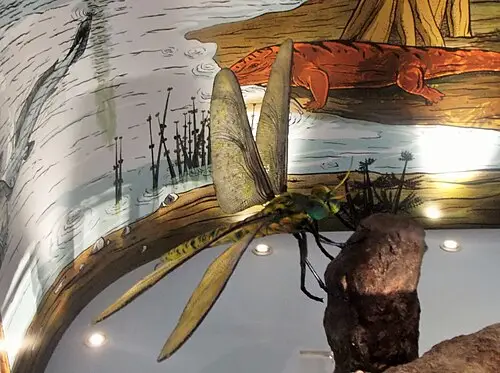
 🎨 Restoration
Restoration: Eunostos · CC BY-SA 4.0 · Wikimedia Commons Source
Life restorations are artistic reconstructions based on fossil evidence; true coloration and soft-tissue details remain uncertain.
Meganeura
Meganeura monyi (Meganeura · Meganeura)
Known only from fossils. The IUCN Red List assesses only species extant since 1500 CE, so fossil taxa are not assigned a category.
💡 Everyday Comparisons for Size, Mass & Speed
- 💡 A wingspan of about 70 cm is slightly shorter than a full-length umbrella (about 80 cm) (Comparison). According to the Natural History Museum, London, it is more than 4 times the wingspan of the largest living dragonfly species (about 16 cm).
- 💡 In an article introducing dragonflies as 'supreme hunters,' the Natural History Museum, London compares the sizes of the largest living dragonfly and the smallest dragonfly.
Reference standards: coach bus ~12 m, mid-size car ~4.9 m, compact car ~1 t, basketball hoop 3.05 m, credit card 8.56 cm.
📖 1. Overview
Meganeura monyi was a giant dragonfly relative (meganeurid) from the Late Carboniferous of Commentry, France, with a wingspan reaching about 70 cm. It is among the largest insects ever to have lived.
🦴 2. Anatomy & Morphology
Its tibiae and tarsi bore strong spines well suited for grasping prey. It is an iconic giant dragonfly-like insect known from incompletely preserved fossils.
🔍 3. Fossil Record & Paleoecology
Studies of giant dragonfly relatives from the same beds show that they were 'hawker'-type predators that hunted on the wing using large compound eyes and strong mandibles. Meganeura monyi is thought to have preyed on large palaeodictyopteran insects.
🇰🇷 4. Connection to Korea
No direct record connecting this species to Korea has been found.
📚 Sources & References
- • Fossil taxon — the IUCN Red List assesses only species living or extinct since 1500
- • paleobiodb.org — basicTaxonInfo
- • wikidata.org — Q30213485
- • commons.wikimedia.org — File:Meganeura monyi au Museum de Toulouse.jpg
- • pmc.ncbi.nlm.nih.gov — PMC6092361
- • nature.com — s41598-018-30629-w
- • nhm.ac.uk — dragonflies-the-ultimate-hunters.html
- • Silhouette: PhyloPic — author not recorded · CC0 1.0 (Congeneric silhouette — Meganeura)
Recorded dimensions are widely cited representative estimates from public literature and may vary by study or specimen.