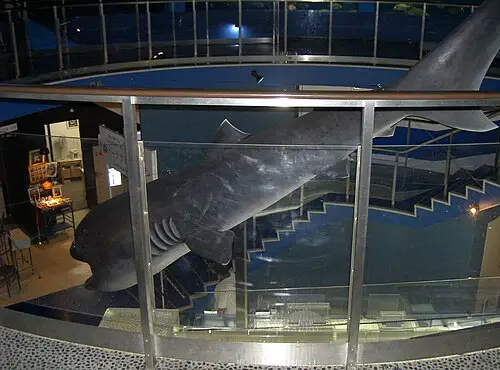
 📸 Photo
Photo: Oos ( talk ) · CC BY-SA 3.0 · Wikimedia Commons Source
Megamouth shark
Megachasma pelagios (Megamouth shark · メガマウス)
💡 Everyday Comparisons for Size, Mass & Speed
- 💡 Its maximum length of 5.5 m is about 1.2 times the length of a passenger car (about 4.5 m) (Comparison).
- 💡 Its maximum weight of 1,040 kg is comparable to a compact passenger car (about 1 ton) (Comparison).
- 💡 Specimens are used for research and education, and in Brazil, Taiwan, and the Philippines it has also been eaten when caught (Animal Diversity Web).
Reference standards: coach bus ~12 m, mid-size car ~4.9 m, compact car ~1 t, basketball hoop 3.05 m, credit card 8.56 cm.
Site-computed relative index from recorded values; not a formal scientific metric.
📖 1. Overview
The megamouth shark is a shark with an enormous mouth, just as its name suggests, filter-feeding on krill in the deep open ocean. Following its prey, it moves deeper during the day and shallower at night.
🦴 2. Anatomy & Morphology
Its mouth is huge and located at the front tip of the body, while the snout is short and rounded. Its jaws extend past the eyes and are lined with rows of small, hook-shaped teeth on both top and bottom. Its belly is white, its back is gray, and there are dark spots under the lower jaw.
🔍 3. Ecology & Behavior
It feeds mainly on krill (euphausiids) and copepods, and occasionally eats jellyfish. It migrates up and down along with its prey, which stays deeper by day and rises shallower at night.
🇰🇷 4. Connection to Korea
No direct record connecting this species to Korea has been found.
📚 Sources & References
- • IUCN Red List LC (2019) — https://www.iucnredlist.org/species/39338/124402302
- • IUCN Red List category LC — latest assessment at iucnredlist.org
- • catalogueoflife.org — 3YR3B
- • iucnredlist.org — 124402302
- • wikidata.org — Q106728
- • commons.wikimedia.org — File:Mega mouth shark specimen.jpg
- • animaldiversity.org — Megachasma pelagios
- • fishbase.se — Megachasma-pelagios.html
Recorded dimensions are widely cited representative estimates from public literature and may vary by study or specimen.