 📸 Photo
Photo: Public domain · Public domain · Wikimedia Commons Source
Basking shark
Cetorhinus maximus (Basking shark · ウバザメ)
💡 Everyday Comparisons for Size, Mass & Speed
- 💡 Its maximum adult body length of 11 m is similar to the length of a city bus (about 11 m) (Comparison).
- 💡 The 6,000 L of water it filters in an hour equals the volume of 30 bathtubs (about 200 L each) (Comparison).
- 💡 Because its liver is large enough to make up most of its body mass, the oil obtained from it has been used in cosmetics such as lotions and hair products, leading to heavy fishing (Animal Diversity Web).
Reference standards: coach bus ~12 m, mid-size car ~4.9 m, compact car ~1 t, basketball hoop 3.05 m, credit card 8.56 cm.
Site-computed relative index from recorded values; not a formal scientific metric.
📖 1. Overview
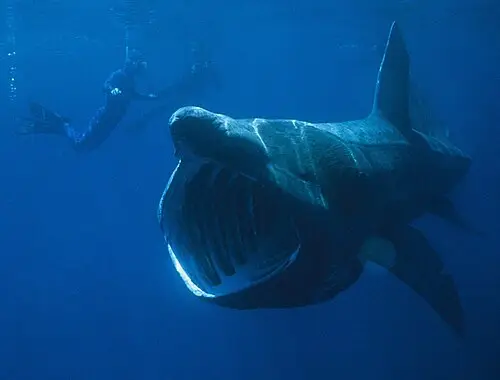
The Basking shark is the second-largest shark after the whale shark, swimming with its mouth wide open to filter plankton. Its English name comes from its habit of floating near the sunlit surface as if basking in the sun.
🦴 2. Anatomy & Morphology
It has a cone-shaped snout and gill slits so large that they nearly encircle the head. The comb-like gill rakers at the front of the gills are 10–12 cm long, and its teeth are tiny at 3–4 mm but number up to 1,200.
🔍 3. Ecology & Behavior
It chooses places dense with zooplankton, such as thermal fronts where water temperatures meet, swimming with its mouth open and closing it every 30–60 seconds to filter water. It filters an average of 6,000 L of water per hour and moves south in winter.
🇰🇷 4. Connection to Korea
It is a species recorded in Korea and listed on the National List of Species of Korea.
📚 Sources & References
- • IUCN Red List EN (2021) — https://www.iucnredlist.org/species/4292/194720078
- • IUCN Red List category EN — latest assessment at iucnredlist.org
- • catalogueoflife.org — T72Q
- • iucnredlist.org — 194720078
- • 국가생물종목록(국립생물자원관) ktsn 120000057267 — https://species.nibr.go.kr/home/mainHome.do?cont_link=009&subMenu=009002&contCd=009002&ktsn=120000057267
- • wikidata.org — Q185260
- • commons.wikimedia.org — File:Basking Shark.jpg
- • animaldiversity.org — Cetorhinus maximus
- • fishbase.se — Cetorhinus-maximus.html
- • Silhouette: PhyloPic — Marina Vingiani · CC BY 4.0
Recorded dimensions are widely cited representative estimates from public literature and may vary by study or specimen.