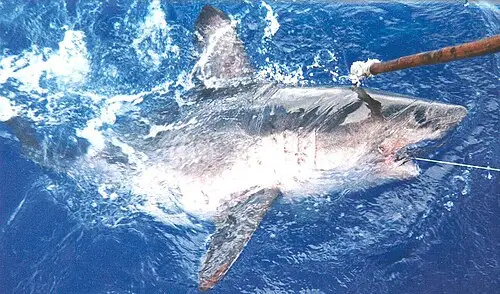
 📸 Photo
Photo: PIRO-NOAA Observer Program · Public domain · Wikimedia Commons Source
Salmon shark
Lamna ditropis (Salmon shark · ネズミザメ)
💡 Everyday Comparisons for Size, Mass & Speed
- 💡 Its maximum total length of 3.05 m is about 2/3 the length of a passenger car (about 4.5 m) (Comparison).
- 💡 In Japan, salmon shark hearts are eaten raw as sashimi, and because its meat and fins are also valuable, it is often caught as bycatch when fishing for other species (Animal Diversity Web).
- 💡 In summer and autumn, when salmon return to rivers to spawn, salmon sharks gather along the coast of Alaska (Animal Diversity Web).
Reference standards: coach bus ~12 m, mid-size car ~4.9 m, compact car ~1 t, basketball hoop 3.05 m, credit card 8.56 cm.
Site-computed relative index from recorded values; not a formal scientific metric.
📖 1. Overview
The salmon shark is a medium-sized shark living in the cold waters of the North Pacific, gathering along the Alaskan coast in pursuit of salmon. It travels alone or in small groups.
🦴 2. Anatomy & Morphology
Full-grown individuals weigh 220 kg or more, and at the same length, eastern Pacific individuals are heavier than western Pacific ones. Shark length is often measured as precaudal length, excluding the tail fin.
🔍 3. Ecology & Behavior
It feeds on various fish including Pacific salmon, herring, sardines, pollock, Pacific sauries, and mackerel. It is ovoviviparous, giving birth to up to 4 young per litter after nourishing them inside the mother's body, and migrates seasonally following prey.
🇰🇷 4. Connection to Korea
It is a species recorded in Korea and listed on the National List of Species of Korea.
📚 Sources & References
- • IUCN Red List LC (2019) — https://www.iucnredlist.org/species/39342/124402990
- • IUCN Red List category LC — latest assessment at iucnredlist.org
- • catalogueoflife.org — 6NVXX
- • iucnredlist.org — 124402990
- • 국가생물종목록(국립생물자원관) ktsn 120000057274 — https://species.nibr.go.kr/home/mainHome.do?cont_link=009&subMenu=009002&contCd=009002&ktsn=120000057274
- • wikidata.org — Q74371
- • commons.wikimedia.org — File:Lamna ditropis.jpg
- • fishbase.se — Lamna-ditropis.html
- • animaldiversity.org — Lamna ditropis
- • Silhouette: PhyloPic — Ignacio Contreras · CC BY 3.0 (Congeneric silhouette — Lamna nasus)
Recorded dimensions are widely cited representative estimates from public literature and may vary by study or specimen.