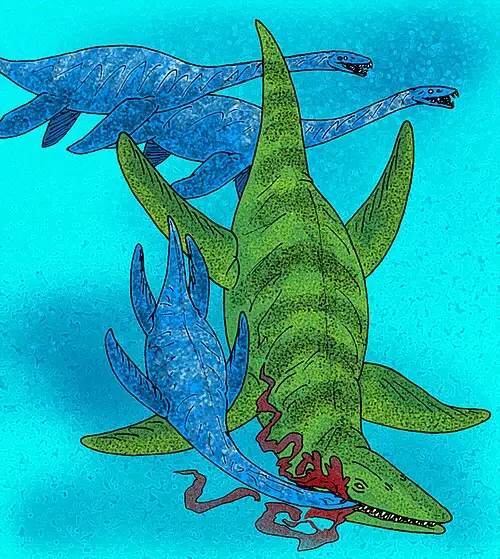
 🎨 Restoration
Restoration: Apokryltaros at English Wikipedia · CC BY 2.5 · Wikimedia Commons Source
Life restorations are artistic reconstructions based on fossil evidence; true coloration and soft-tissue details remain uncertain.
Kronosaurus
Kronosaurus queenslandicus (Kronosaurus · Kronosaurus)
Known only from fossils. The IUCN Red List assesses only species extant since 1500 CE, so fossil taxa are not assigned a category.
💡 Everyday Comparisons for Size, Mass & Speed
- 💡 An estimated body length of about 10 m is slightly shorter than a city bus (about 12 m long). A single skull at 2.4 m is longer than the height of an adult human (Comparison).
- 💡 The Australian Museum notes that the mounted skeleton erected at Harvard University, at 12.8 m, was restored about 3 m longer than its actual length.
Reference standards: coach bus ~12 m, mid-size car ~4.9 m, compact car ~1 t, basketball hoop 3.05 m, credit card 8.56 cm.
📖 1. Overview
Kronosaurus queenslandicus (genus Kronosaurus) was the largest pliosaur that lived in the inland sea of Australia during the Early Cretaceous. A jawbone fragment was first discovered near Hughenden in Queensland.
🦴 2. Anatomy & Morphology
Its skull was at least 2.4 m long, but its total body length did not exceed 10 m. Its conical teeth were well suited for crushing hard prey such as ammonites.
🔍 3. Fossil Record & Paleoecology
It likely hunted large fish, invertebrates such as giant squid and ammonites, and other marine reptiles. It lived in a cold, high-latitude inland sea.
🇰🇷 4. Connection to Korea
No direct record connecting this species to Korea has been found.
📚 Sources & References
- • Fossil taxon — the IUCN Red List assesses only species living or extinct since 1500
- • paleobiodb.org — basicTaxonInfo
- • wikidata.org — Q103826200
- • commons.wikimedia.org — File:Kronosaurus queenslandicus QM F18827 proposed neotype.j
- • australian.museum — kronosaurus-queenslandicus
- • Silhouette: PhyloPic — Dann Pigdon · CC0 1.0 (Congeneric silhouette — Kronosaurus)
Recorded dimensions are widely cited representative estimates from public literature and may vary by study or specimen.