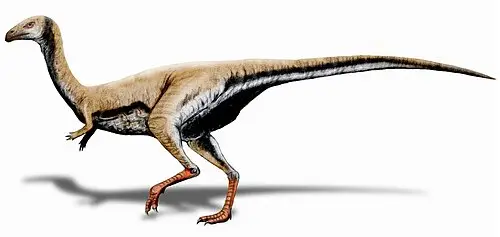
 🎨 Restoration
Restoration: Nobu Tamura · CC BY 3.0 · Wikimedia Commons Source
Life restorations are artistic reconstructions based on fossil evidence; true coloration and soft-tissue details remain uncertain.
Limusaurus
Limusaurus inextricabilis (Limusaurus · Limusaurus)
Known only from fossils. The IUCN Red List assesses only species extant since 1500 CE, so fossil taxa are not assigned a category.
💡 Everyday Comparisons for Size, Mass & Speed
- 💡 Having a beak instead of teeth when grown can be compared to how modern birds such as chickens or sparrows eat with toothless beaks (Comparison).
- 💡 Holding stones (gastroliths) in its stomach can be seen as serving a similar purpose to how chickens swallow small stones with their feed to grind food in the gizzard (Comparison).
Reference standards: coach bus ~12 m, mid-size car ~4.9 m, compact car ~1 t, basketball hoop 3.05 m, credit card 8.56 cm.
📖 1. Overview
Limusaurus inextricabilis (genus Limusaurus) was a ceratosaurian dinosaur that lived in the Xinjiang region of China during the Late Jurassic about 159 million years ago; it had teeth when young but developed a toothless beak as it grew.
🦴 2. Anatomy & Morphology
Hatchlings and juveniles had jaws full of teeth, whereas fully grown adults had toothless, beak-like jaws. The research team identified 78 growth changes across 19 specimens.
🔍 3. Fossil Record & Paleoecology
The loss of teeth is interpreted as indicating a shift in diet from omnivory in youth to herbivory in adulthood, supported by gastroliths in the stomach and stable isotope analyses.
🇰🇷 4. Connection to Korea
No direct record connecting this species to Korea has been found.
📚 Sources & References
- • Fossil taxon — the IUCN Red List assesses only species living or extinct since 1500
- • paleobiodb.org — basicTaxonInfo
- • wikidata.org — Q20718640
- • commons.wikimedia.org — File:Limusaurus inextricabilis skeleton.jpg
- • doi.org — j.cub.2016.10.043
- • sci.news — limusaurus-inextricabilis-beaked-bird-like-dinosaur-04478.ht
- • doi.org — s41598-018-28154-x
- • Silhouette: PhyloPic — Tasman Dixon · CC BY 4.0 (Related taxon silhouette — Vespersaurus paranaensis)
Recorded dimensions are widely cited representative estimates from public literature and may vary by study or specimen.