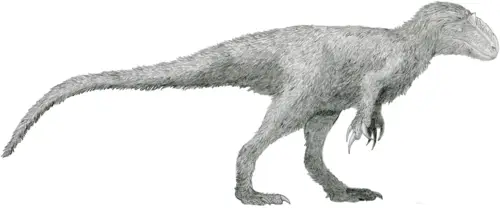
 🎨 Restoration
Restoration: Tomopteryx · CC BY-SA 4.0 · Wikimedia Commons Source
Life restorations are artistic reconstructions based on fossil evidence; true coloration and soft-tissue details remain uncertain.
Yutyrannus
Yutyrannus huali (Yutyrannus · Yutyrannus)
Known only from fossils. The IUCN Red List assesses only species extant since 1500 CE, so fossil taxa are not assigned a category.
💡 Everyday Comparisons for Size, Mass & Speed
- 💡 Its estimated body length of 7.5 m is shorter than a city bus (about 10–12 m) and a little over one and a half passenger cars (about 4.5 m) (Comparison).
- 💡 Its estimated weight of about 1,100 kg is similar to the weight of a small passenger car (Comparison).
Reference standards: coach bus ~12 m, mid-size car ~4.9 m, compact car ~1 t, basketball hoop 3.05 m, credit card 8.56 cm.
Site-computed relative index from recorded values; not a formal scientific metric.
📖 1. Overview
Yutyrannus huali (genus Yutyrannus) was a large carnivorous dinosaur that lived in northern China about 125 million years ago, and is the largest dinosaur known with preserved feather impressions.
🦴 2. Anatomy & Morphology
Because it belonged to an early branch of tyrannosauroids, unlike the later Tyrannosaurus it had long forelimbs with three fingers on each hand. It had a low crest along the midline of its skull and two short horns near the eyes.
🔍 3. Fossil Record & Paleoecology
Because three skeletons were found together at the same site, some researchers suggest it may have hunted in packs. As the specimens reached researchers through fossil dealers, the exact locality is known only as a quarry in Liaoning.
🇰🇷 4. Connection to Korea
No direct record connecting this species to Korea has been found.
📚 Sources & References
- • Fossil taxon — the IUCN Red List assesses only species living or extinct since 1500
- • paleobiodb.org — basicTaxonInfo
- • wikidata.org — Q20719595
- • commons.wikimedia.org — File:Laika ac Dino Kingdom 2012 (7882288828).jpg
- • nhm.ac.uk — yutyrannus.html
- • Silhouette: PhyloPic — Tasman Dixon · CC0 1.0
Recorded dimensions are widely cited representative estimates from public literature and may vary by study or specimen.