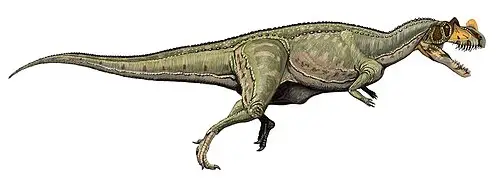
 🎨 Restoration
Restoration: DiBgd at English Wikipedia , Bogdanov dmitrchel@mail.ru · CC BY 2.5 · Wikimedia Commons Source
Life restorations are artistic reconstructions based on fossil evidence; true coloration and soft-tissue details remain uncertain.
Ceratosaurus
Ceratosaurus nasicornis (Ceratosaurus · Ceratosaurus)
Known only from fossils. The IUCN Red List assesses only species extant since 1500 CE, so fossil taxa are not assigned a category.
💡 Everyday Comparisons for Size, Mass & Speed
- 💡 An estimated body length of about 7 m (representative value for the genus) is about 1.5 times the length of a passenger car (about 4.5 m), and a weight of about 980 kg is lighter than a single passenger car (about 1.5 tons) (Comparison).
- 💡 Museum guides explain that the horn on its nose was likely used for display.
Reference standards: coach bus ~12 m, mid-size car ~4.9 m, compact car ~1 t, basketball hoop 3.05 m, credit card 8.56 cm.
Site-computed relative index from recorded values; not a formal scientific metric.
📖 1. Overview
Ceratosaurus nasicornis (genus Ceratosaurus) was a carnivorous theropod that lived in North America and Europe (Portugal) during the Late Jurassic. Its name means "horned lizard."
🦴 2. Anatomy & Morphology
It had a single horn on its nose and a single row of small bony plates running along its back. The nasal horn was too small and weak for fighting, so it was likely used for display.
🔍 3. Fossil Record & Paleoecology
It was an active predator that hunted herbivorous dinosaurs and may also have fed on aquatic animals or carrion. Because all known individuals were found alone, there is no evidence of pack hunting.
🇰🇷 4. Connection to Korea
No direct record connecting this species to Korea has been found.
📚 Sources & References
- • Fossil taxon — the IUCN Red List assesses only species living or extinct since 1500
- • paleobiodb.org — basicTaxonInfo
- • wikidata.org — Q20717500
- • commons.wikimedia.org — File:Ceratosaurus nasicornis DB.jpg
- • nhm.ac.uk — ceratosaurus.html
- • Silhouette: PhyloPic — Tasman Dixon · CC0 1.0
Recorded dimensions are widely cited representative estimates from public literature and may vary by study or specimen.