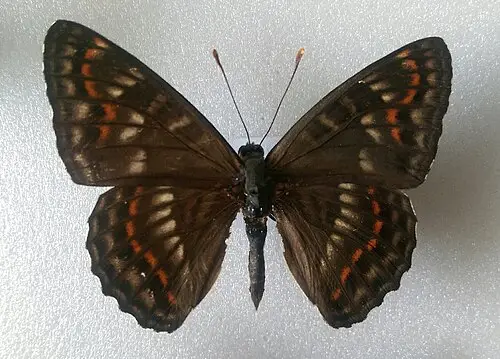
 📸 Photo
Photo: Anaxibia · CC BY-SA 4.0 · Wikimedia Commons Source
Limenitis pratti
Limenitis pratti (Limenitis pratti · Limenitis pratti)
Not Evaluated (NE) on the IUCN Red List yet.
🇰🇷 Class II endangered wildlife (Korea)
💡 Everyday Comparisons for Size, Mass & Speed
- 💡 A maximum wingspan of 60 mm is about 2.3 times the diameter of a Korean 500-won coin (26.5 mm) (Comparison).
- 💡 The Korean pine that the larvae eat is also the tree that produces edible pine nuts. This butterfly lives in forests where Korean pines grow.
Reference standards: coach bus ~12 m, mid-size car ~4.9 m, compact car ~1 t, basketball hoop 3.05 m, credit card 8.56 cm.
📖 1. Overview
Limenitis pratti is a butterfly living in mountain forests such as Seoraksan and Odaesan in Gangwon-do, named in Korean after the red stripe on its wings. It is a Class II endangered wildlife species in Korea.
🦴 2. Anatomy & Morphology
Its wingspan is 57–60 mm, with yellowish-brown spots and an outer red stripe on blackish-brown wings. The base of the hindwing has 3 black spots on a yellow background.
🔍 3. Ecology & Behavior
It appears once a year from June to August, overwinters as a 3rd-instar larva, and pupates around June. Unusually for a butterfly, the larva feeds on the needles of the Korean pine, a conifer.
🇰🇷 4. Connection to Korea
It is a Class II endangered wildlife species (Korea). Mainly inhabiting mountain areas such as Seoraksan and Odaesan in Gangwon-do, it prefers low temperatures and is affected by rising temperatures, and its narrow home range makes moving to new habitats difficult.
📚 Sources & References
- • 멸종위기 야생생물 Ⅱ급 — 국가생물종목록(국립생물자원관) ktsn 120000212310 — https://species.nibr.go.kr/home/mainHome.do?cont_link=009&subMenu=009002&contCd=009002&ktsn=120000212310
- • IUCN Red List: not evaluated (NE) — cross-checked with the Wikidata conservation-status entry
- • Korean protection status: Class II endangered wildlife (Korea)
- • catalogueoflife.org — 6QB3C
- • 국가생물종목록(국립생물자원관) ktsn 120000212310 — https://species.nibr.go.kr/home/mainHome.do?cont_link=009&subMenu=009002&contCd=009002&ktsn=120000212310
- • wikidata.org — Q13575906
- • nie.re.kr — view.do
- • bok.or.kr — contents.do
- • Silhouette: PhyloPic — Didier Descouens · CC BY 4.0 (Congeneric silhouette — Limenitis reducta)
Recorded dimensions are widely cited representative estimates from public literature and may vary by study or specimen.