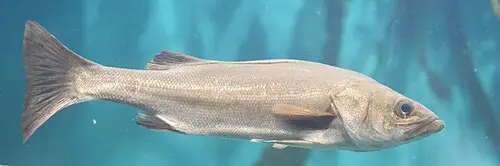
 📸 Photo
Photo: Kinori · CC0 · Wikimedia Commons Source
Japanese seabass
Lateolabrax japonicus (Japanese seabass · スズキ)
💡 Everyday Comparisons for Size, Mass & Speed
- 💡 Korea Policy Briefing (2020) introduces Japanese seabass sashimi as becoming sweeter the more it is chewed and enjoyed as aged sashimi, while the flesh is also eaten as steak and the bones are used for soup.
- 💡 Its maximum length of 102 cm is about 60% of an adult human's height (about 1.7 m) (Comparison).
Reference standards: coach bus ~12 m, mid-size car ~4.9 m, compact car ~1 t, basketball hoop 3.05 m, credit card 8.56 cm.
Site-computed relative index from recorded values; not a formal scientific metric.
📖 1. Overview
The Japanese seabass is a fish living in coastal waters of the western Pacific from Japan to the South China Sea, moving between seawater and freshwater.
🦴 2. Anatomy & Morphology
It is known to reach a maximum total length of 102 cm and a maximum weight of 8.7 kg.
🔍 3. Ecology & Behavior
Juveniles feed on zooplankton while adults eat small fish and shrimp, spawning in winter on deep rocky reefs or in coastal waters.
🇰🇷 4. Connection to Korea
It is listed on the National List of Species of Korea (National Institute of Biological Resources (NIBR)), and Korea Policy Briefing (2020) notes that unlike most raw fish dishes whose flavor drops in summer, Japanese seabass tastes better in summer.
📚 Sources & References
- • IUCN Red List LC (2023) — https://www.iucnredlist.org/species/166961/1157356
- • IUCN Red List category LC — latest assessment at iucnredlist.org
- • catalogueoflife.org — 3SHXM
- • iucnredlist.org — 1157356
- • 국가생물종목록(국립생물자원관) ktsn 120000058311 — https://species.nibr.go.kr/home/mainHome.do?cont_link=009&subMenu=009002&contCd=009002&ktsn=120000058311
- • wikidata.org — Q1151311
- • commons.wikimedia.org — File:スズキ.jpg
- • fishbase.se — Lateolabrax-japonicus.html
- • species.nibr.go.kr — general-search
- • korea.kr — cultureColumnView.do
- • Silhouette: PhyloPic — Lihao · CC0 1.0 (Congeneric silhouette — Lateolabrax maculatus)
Recorded dimensions are widely cited representative estimates from public literature and may vary by study or specimen.