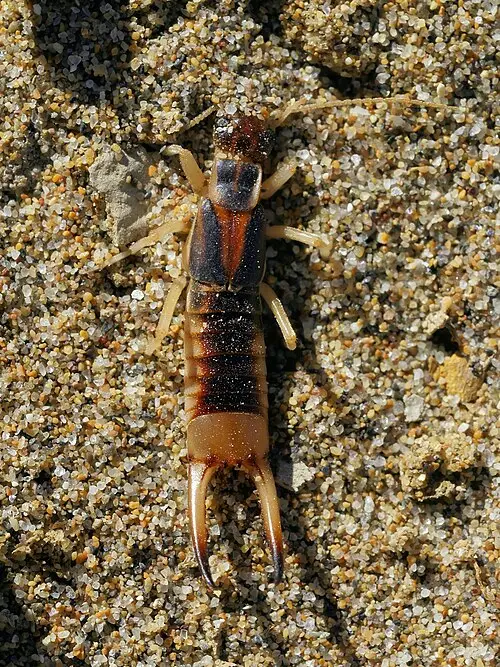
 📸 Photo
Photo: Hans Hillewaert · CC BY-SA 4.0 · Wikimedia Commons Source
Tawny earwig
Labidura riparia (Tawny earwig · Tawny earwig)
Not Evaluated (NE) on the IUCN Red List yet.
💡 Everyday Comparisons for Size, Mass & Speed
- 💡 A body length of 30 mm is slightly longer than the diameter of a Korean 100-won coin (24 mm) (Comparison).
- 💡 It can mainly be seen on sandy ground by rivers, lakes, and ponds (National List of Species of Korea).
Reference standards: coach bus ~12 m, mid-size car ~4.9 m, compact car ~1 t, basketball hoop 3.05 m, credit card 8.56 cm.
📖 1. Overview
The tawny earwig is an earwig mainly seen on sandy riverbanks and lakeshores, characterized by the large forceps of the male.
🦴 2. Anatomy & Morphology
The body length is 25–30 mm, and its color is reddish brown, dark brown, or yellowish brown. The antennae have 30–32 segments; the male's forceps spread wide apart at the base, while the female's forceps are slender and long.
🔍 3. Ecology & Behavior
It is mainly found in areas with sandy ground such as riverbanks, lakes, and ponds. It usually has forewings (elytra), with shortened hindwings protruding slightly only very rarely.
🇰🇷 4. Connection to Korea
It is listed as 'Keun-jip-ge-beol-le' (Korean name) on the National List of Species of Korea (Korean populations belong to the subspecies L. riparia japonica) and is distributed from central Korea southward.
📚 Sources & References
- • IUCN Red List: not evaluated (NE) — cross-checked with the Wikidata conservation-status entry
- • catalogueoflife.org — 3RJLW
- • 국가생물종목록(국립생물자원관) ktsn 120000020868 — https://species.nibr.go.kr/home/mainHome.do?cont_link=009&subMenu=009002&contCd=009002&ktsn=120000020868
- • wikidata.org — Q728526
- • commons.wikimedia.org — File:Labidura riparia.jpg
- • species.nibr.go.kr — mainHome.do
- • Silhouette: PhyloPic — author not recorded · CC0 1.0
Recorded dimensions are widely cited representative estimates from public literature and may vary by study or specimen.