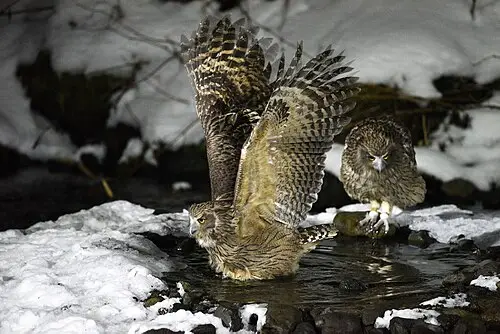
 📸 Photo
Photo: Takashi Muramatsu · CC BY 2.0 · Wikimedia Commons Source
Blakiston's Fish Owl
Ketupa blakistoni (Blakiston's Fish Owl · Blakiston's Fish Owl)
💡 Everyday Comparisons for Size, Mass & Speed
- 💡 A maximum wingspan of 2 m is taller than an adult human, and a maximum weight of 4 kg is about two-fifths (2/5) of a 10 kg bag of rice (Comparison).
- 💡 Because it is a fish-eating owl, it can only live where both clear rivers and large trees are present together (ADW habitat description).
Reference standards: coach bus ~12 m, mid-size car ~4.9 m, compact car ~1 t, basketball hoop 3.05 m, credit card 8.56 cm.
Site-computed relative index from recorded values; not a formal scientific metric.
📖 1. Overview
Blakiston's fish owl is a large fish-eating owl that lives in riverside forests. It requires open water where it can catch fish and large trees with nest cavities to survive. On the IUCN Red List, it is assessed as Vulnerable (VU, 2025 assessment).
🦴 2. Anatomy & Morphology
With a body length of 60–71 cm, a wingspan of up to about 2 m, and a weight of 2.7–4 kg, it is among the larger owls, and males are smaller than females.
🔍 3. Ecology & Behavior
It catches fish from open water or holes in the ice, and also hunts crayfish and frogs in shallow water or on the ground. In harsh winters, it also eats mammals and waterfowl. It lays 1–3 eggs per clutch and breeds on average about once every 2 years.
🇰🇷 4. Connection to Korea
ADW includes North Korea in the distribution range of this bird, but there is no record of it on the National List of Species of Korea.
📚 Sources & References
- • IUCN Red List VU (2025) — https://www.iucnredlist.org/species/22689007/249243772
- • IUCN Red List category VU — latest assessment at iucnredlist.org
- • doi.org — avilist.v2026
- • iucnredlist.org — 249243772
- • wikidata.org — Q25654576
- • commons.wikimedia.org — File:A couple of Blakiston's fish owls (1) (31558421096).jpg
- • animaldiversity.org — Bubo blakistoni
- • Silhouette: PhyloPic — Rachel T Mason · CC0 1.0 (Related taxon silhouette — Ninox strenua)
Recorded dimensions are widely cited representative estimates from public literature and may vary by study or specimen.