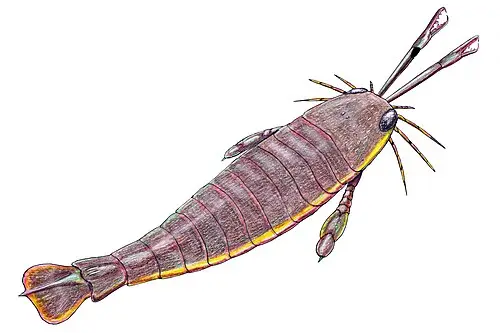
 🎨 Restoration
Restoration: ДиБгд · CC BY-SA 4.0 · Wikimedia Commons Source
Life restorations are artistic reconstructions based on fossil evidence; true coloration and soft-tissue details remain uncertain.
Jaekelopterus
Jaekelopterus rhenaniae (Jaekelopterus · ジェケロプテルス)
Known only from fossils. The IUCN Red List assesses only species extant since 1500 CE, so fossil taxa are not assigned a category.
💡 Everyday Comparisons for Size, Mass & Speed
- 💡 A body length of about 2.5 m is about 1.5 times the height of an adult human (about 1.7 m) (Comparison).
- 💡 A pincer length of about 45.5 cm is about 1.5 times the long side of an A4 sheet of paper (29.7 cm) (Comparison). The study that estimated its body size from a single pincer led to the conclusion that it was the "largest arthropod."
Reference standards: coach bus ~12 m, mid-size car ~4.9 m, compact car ~1 t, basketball hoop 3.05 m, credit card 8.56 cm.
📖 1. Overview
Jaekelopterus rhenaniae (genus Jaekelopterus) was a giant sea scorpion (eurypterid) that lived in the region of Germany during the Early Devonian and is counted among the largest arthropods ever to evolve. Its size became known in 2007 from a single claw fossil.
🦴 2. Anatomy & Morphology
Its pincer (chelicera) was shaped like a large hook estimated at about 45.5 cm in length when fully grown. From the length of this pincer, its body length is estimated at about 2.5 m.
🔍 3. Fossil Record & Paleoecology
The paper regards it as a top predator of coastal waters that ate early vertebrates, smaller arthropods, and even members of its own group. Researchers point out that with such a massive body, walking on land would have been difficult.
🇰🇷 4. Connection to Korea
No direct record connecting this species to Korea has been found.
📚 Sources & References
- • Fossil taxon — the IUCN Red List assesses only species living or extinct since 1500
- • paleobiodb.org — basicTaxonInfo
- • wikidata.org — Q141284
- • commons.wikimedia.org — File:Jaekelopterus rhenaniae.jpg
- • pmc.ncbi.nlm.nih.gov — PMC2412931
- • Silhouette: PhyloPic — Gareth Monger · CC BY 3.0
Recorded dimensions are widely cited representative estimates from public literature and may vary by study or specimen.