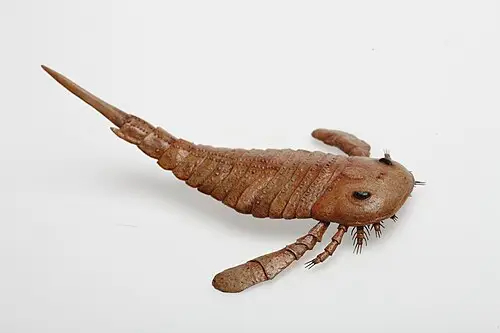
 🎨 Restoration
Restoration: Maker: Michael Pennell, Photographer: Jon Augier · CC BY 4.0 · Wikimedia Commons Source
Life restorations are artistic reconstructions based on fossil evidence; true coloration and soft-tissue details remain uncertain.
Eurypterus
Eurypterus remipes (Eurypterus · Eurypterus)
Known only from fossils. The IUCN Red List assesses only species extant since 1500 CE, so fossil taxa are not assigned a category.
💡 Everyday Comparisons for Size, Mass & Speed
- 💡 Fossils of this species are designated as the state fossil of New York in the United States (National Park Service state fossil list; UCMP notes that it was designated in 1984).
- 💡 Some sea scorpions exceeded 8 feet (about 2.4 m), making them taller than a human (Comparison). However, that is the maximum for the group as a whole, not the size of this species.
Reference standards: coach bus ~12 m, mid-size car ~4.9 m, compact car ~1 t, basketball hoop 3.05 m, credit card 8.56 cm.
📖 1. Overview
Eurypterus remipes is a Silurian sea scorpion (eurypterid) and the state fossil of New York in the United States. National Park Service materials feature a photo of a Silurian fossil of this species from New York.
🦴 2. Anatomy & Morphology
The body of a sea scorpion is made up of segments and ends in a spike-, paddle-, or claw-shaped tail segment (telson). Although it looks like a scorpion's stinger, it is thought to have been unable to sting.
🔍 3. Fossil Record & Paleoecology
Sea scorpions are said to have eaten almost anything they could catch or fit into their mouths, or scavenged carrion, and trilobites may have been common prey. The smallest sea scorpions measured about 10 cm.
🇰🇷 4. Connection to Korea
No direct record connecting this species to Korea has been found.
📚 Sources & References
- • Fossil taxon — the IUCN Red List assesses only species living or extinct since 1500
- • paleobiodb.org — basicTaxonInfo
- • wikidata.org — Q10278317
- • commons.wikimedia.org — File:Eurypterus remipes (fossil sea scorption) Silurian; New
- • nps.gov — fossils-of-the-2013-national-fossil-day-artwork.htm
- • ucmp.berkeley.edu — eurypterida.html
- • home.nps.gov — official-state-fossils.htm
- • Silhouette: PhyloPic — Gareth Monger · CC BY 3.0
Recorded dimensions are widely cited representative estimates from public literature and may vary by study or specimen.