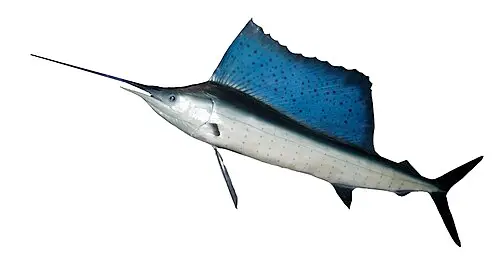
 📸 Photo
Photo: This illustration was made by Citron You must credit this : Citron / CC-BY-SA-3.0 · CC BY-SA 3.0 · Wikimedia Commons Source
Indo-Pacific sailfish
Istiophorus platypterus (Indo-Pacific sailfish · バショウカジキ)
💡 Everyday Comparisons for Size, Mass & Speed
- 💡 A speed of 110 km/h is equal to the maximum speed limit on Korean expressways (110 km/h) (Comparison).
- 💡 Its maximum fork length of 3.48 m is about 1 m shorter than a passenger car (about 4.5 m) (Comparison).
- 💡 In Japan, its meat is used for sashimi and sushi (Animal Diversity Web).
Reference standards: coach bus ~12 m, mid-size car ~4.9 m, compact car ~1 t, basketball hoop 3.05 m, credit card 8.56 cm.
Site-computed relative index from recorded values; not a formal scientific metric.
📖 1. Overview
The Indo-Pacific sailfish is a large fish of the Indian and Pacific Oceans with a sail-like dorsal fin and a long bill. The IUCN (2022) assessed it as Vulnerable (VU).
🦴 2. Anatomy & Morphology
Its body is long, compressed, and streamlined, dark blue on the back and silvery-white on the belly, with about 20 rows of pale blue dotted stripes along the sides. It has a sail-like first dorsal fin (42 to 49 soft rays) and a long bill covered with file-like teeth.
🔍 3. Ecology & Behavior
It feeds on surface fishes such as mackerels, sardines, and anchovies as well as cephalopods, slashing its bill to stun or kill prey before eating. It hunts alone or in small groups and spawns throughout the year.
🇰🇷 4. Connection to Korea
It is listed as “Dotsaechi” (Korean name) in the National List of Species of Korea.
📚 Sources & References
- • IUCN Red List VU (2022) — https://www.iucnredlist.org/species/170338/46649664
- • IUCN Red List category VU — latest assessment at iucnredlist.org
- • catalogueoflife.org — 3QDCH
- • iucnredlist.org — 46649664
- • 국가생물종목록(국립생물자원관) ktsn 120000059181 — https://species.nibr.go.kr/home/mainHome.do?cont_link=009&subMenu=009002&contCd=009002&ktsn=120000059181
- • wikidata.org — Q694527
- • commons.wikimedia.org — File:Istiophorus platypterus.jpg
- • fishbase.se — Istiophorus-platypterus.html
- • animaldiversity.org — Istiophorus platypterus
- • Silhouette: PhyloPic — Felix Vaux · CC0 1.0 (Related taxon silhouette — Kajikia audax)
Recorded dimensions are widely cited representative estimates from public literature and may vary by study or specimen.