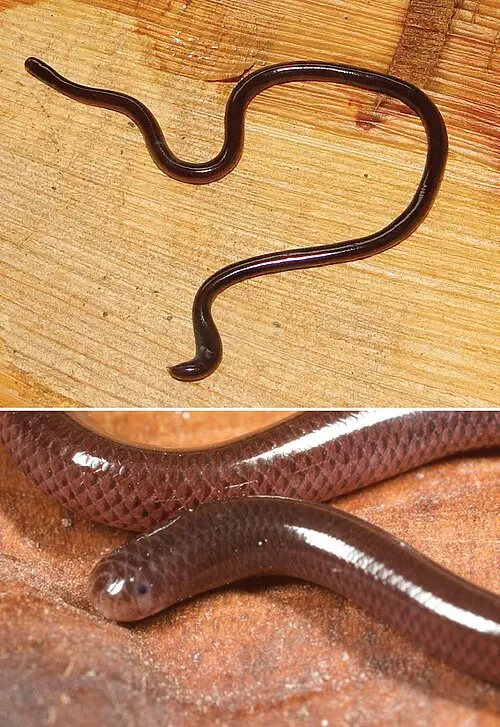
 📸 Photo
Photo: Hinrich Kaiser and Mark O’Shea · CC BY 3.0 · Wikimedia Commons Source
Brahminy Blindsnake
Indotyphlops braminus (Brahminy Blindsnake · ブラーミニメクラヘビ)
💡 Everyday Comparisons for Size, Mass & Speed
- 💡 The upper end of normal adult length, 16.5 cm, is about the length of two credit cards (long side about 8.6 cm) placed end to end (Comparison).
- 💡 It commonly lives under soil and leaf litter in urban gardens and farmlands, eating the eggs and larvae of ants and termites (Florida Museum of Natural History).
Reference standards: coach bus ~12 m, mid-size car ~4.9 m, compact car ~1 t, basketball hoop 3.05 m, credit card 8.56 cm.
📖 1. Overview
The Brahminy Blindsnake is a tiny, worm-like burrowing snake native to South Asia that has spread to many parts of the world through human activity as an introduced species.
🦴 2. Anatomy & Morphology
It is a tiny snake whose adult total length is usually only 11–17 cm. It does not bite; when picked up, it presses its pointed tail tip against the handler and releases a foul-smelling liquid from glands at the base of the tail.
🔍 3. Ecology & Behavior
Burrowing readily through soil, leaf litter, sawdust piles, and rotting logs, it feeds on the eggs, larvae, and pupae of ants and termites. It is an all-female parthenogenetic species that lays 1–8 eggs per clutch.
🇰🇷 4. Connection to Korea
No direct record connecting this species to Korea has been found.
📚 Sources & References
- • IUCN Red List LC (2021) — https://www.iucnredlist.org/species/172704/1370555
- • IUCN Red List category LC — latest assessment at iucnredlist.org
- • catalogueoflife.org — 3PNW8
- • iucnredlist.org — 1370555
- • wikidata.org — Q22299988
- • commons.wikimedia.org — File:Ramphotyphlops braminus in Timor-Leste.jpg
- • floridamuseum.ufl.edu — brahminy-blindsnake
- • reptile-database.reptarium.cz — species
- • Silhouette: PhyloPic — Jessica Tingle · CC0 1.0 (Related taxon silhouette — Afrotyphlops schlegelii)
Recorded dimensions are widely cited representative estimates from public literature and may vary by study or specimen.