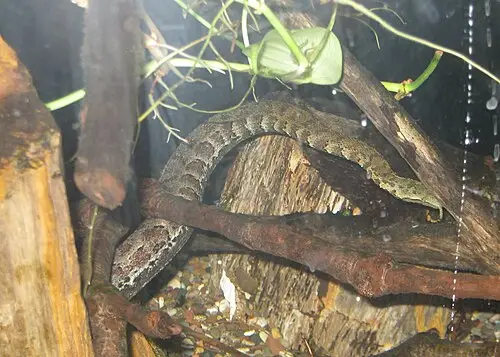
 📸 Photo
Photo: Ruby 1x2 · Public domain · Wikimedia Commons Source
Tentacle Snake
Erpeton tentaculatum (Tentacle Snake · ヒゲミズヘビ)
💡 Everyday Comparisons for Size, Mass & Speed
- 💡 Its average length of 50 cm equals one 30 cm ruler plus 2/3 of another placed end to end (Comparison).
- 💡 Wild-caught individuals are sometimes traded as pets, while rice farming and aquaculture place pressure on its wetland habitats (Smithsonian's National Zoo).
Reference standards: coach bus ~12 m, mid-size car ~4.9 m, compact car ~1 t, basketball hoop 3.05 m, credit card 8.56 cm.
📖 1. Overview
The Tentacle Snake is a fully aquatic snake living in slow-moving freshwaters of Southeast Asia, best known for the pair of tentacles at the tip of its snout.
🦴 2. Anatomy & Morphology
It has two short, scale-covered tentacles on its snout, and nostrils set on the top side that can be closed shut. It is a rear-fanged snake with small fangs toward the back of the mouth.
🔍 3. Ecology & Behavior
Waiting motionless among aquatic plants, it jerks its body to create a water wave that drives fish toward its mouth; it eats almost exclusively fish and rarely frogs or crabs. It is ovoviviparous, giving birth to live young that also eat only small fish.
🇰🇷 4. Connection to Korea
No direct record connecting this species to Korea has been found.
📚 Sources & References
- • IUCN Red List LC (2010) — https://www.iucnredlist.org/species/176697/7285596
- • IUCN Red List category LC — latest assessment at iucnredlist.org
- • catalogueoflife.org — 3B9FS
- • iucnredlist.org — 7285596
- • wikidata.org — Q1480644
- • commons.wikimedia.org — File:Tentacled Snake at Zoo.jpg
- • nationalzoo.si.edu — tentacled-snake
- • reptile-database.reptarium.cz — species
- • Silhouette: PhyloPic — Beth Reinke · CC0 1.0 (Related taxon silhouette — Enhydris enhydris)
Recorded dimensions are widely cited representative estimates from public literature and may vary by study or specimen.