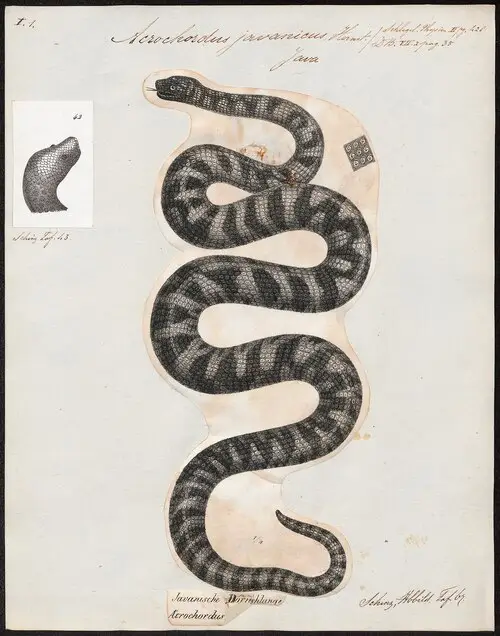
 📸 Photo
Photo: Public domain · Public domain · Wikimedia Commons Source
Elephant Trunk Snake
Acrochordus javanicus (Elephant Trunk Snake · ジャワヤスリヘビ)
💡 Everyday Comparisons for Size, Mass & Speed
- 💡 Its skin is used to manufacture leather goods (ADW 'Economic Importance for Humans: Positive').
- 💡 Its maximum weight of 10 kg is half of a 20 kg bag of rice (Comparison).
- 💡 A female's maximum length of about 2.4 m is similar to the ceiling height of an apartment room (Comparison).
Reference standards: coach bus ~12 m, mid-size car ~4.9 m, compact car ~1 t, basketball hoop 3.05 m, credit card 8.56 cm.
Site-computed relative index from recorded values; not a formal scientific metric.
📖 1. Overview
The Elephant Trunk Snake is an aquatic snake living in brackish river mouths and estuaries, notable for its loose, baggy skin.
🦴 2. Anatomy & Morphology
Males grow up to about 5 feet (1.5 m), while females are larger and heavier-bodied, reaching up to about 8 feet (2.4 m). Its skin is loose, covered with small, rough scales placed side by side without overlapping, each bearing a sharp triangular ridge.
🔍 3. Ecology & Behavior
It hides during the day and is mainly active at night, wrapping its body around fish and frogs with its prehensile tail and rough, sharp scales. It stays mostly underwater, holding its breath for up to 40 minutes, and gives birth to 20–30 live young at a time.
🇰🇷 4. Connection to Korea
No direct record connecting this species to Korea has been found.
📚 Sources & References
- • IUCN Red List LC (2012) — https://www.iucnredlist.org/species/176718/1443749
- • IUCN Red List category LC — latest assessment at iucnredlist.org
- • catalogueoflife.org — 9LSZ
- • iucnredlist.org — 1443749
- • wikidata.org — Q2447437
- • commons.wikimedia.org — File:Acrochordus javanicus - 1700-1880 - Print - Iconographi
- • animaldiversity.org — Acrochordus javanicus
- • Silhouette: PhyloPic — Christina Zdenek · CC BY 4.0 (Congeneric silhouette — Acrochordus granulatus)
Recorded dimensions are widely cited representative estimates from public literature and may vary by study or specimen.