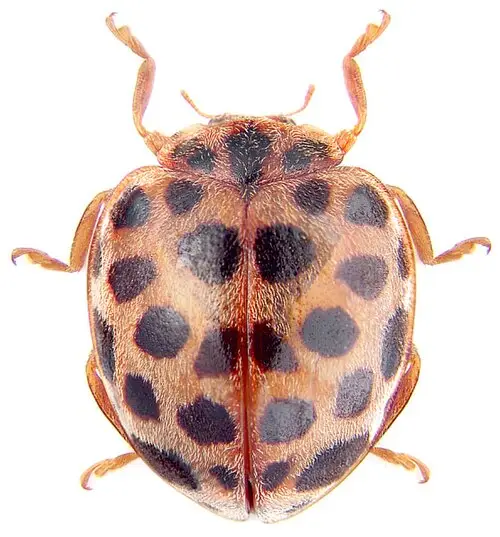
 📸 Photo
Photo: Кирилл Владимирович Макаров, д-р биол. наук · CC BY-SA 4.0 · Wikimedia Commons Source
28-spotted lady beetle
Henosepilachna vigintioctomaculata (28-spotted lady beetle · オオニジュウヤホシテントウ)
Not Evaluated (NE) on the IUCN Red List yet.
💡 Everyday Comparisons for Size, Mass & Speed
- 💡 Because the National List of Species of Korea notes that larvae and adults damage potato leaves, it is a pest that can be seen on the leaves of potato fields and nightshade crops.
- 💡 It can be observed from April to October and produces 3 generations in 1 year (National List of Species of Korea).
Reference standards: coach bus ~12 m, mid-size car ~4.9 m, compact car ~1 t, basketball hoop 3.05 m, credit card 8.56 cm.
📖 1. Overview
The 28-spotted lady beetle is a ladybird that feeds on the leaves of potatoes and nightshade-family plants rather than aphids. It lives throughout Korea and is also distributed in Japan, China, Russia, Nepal, and Southeast Asia.
🦴 2. Anatomy & Morphology
Because the black spots on its elytra are generally larger than those of Isippal-jeombagi-mudangbeolle (a Korean animal name) and their arrangement differs, careful observation is needed to tell them apart.
🔍 3. Ecology & Behavior
Both larvae and adults are known to chew on the leaves of potatoes and other nightshade-family plants. It can be seen from April to October, produces 3 generations in 1 year, and overwinters as an adult.
🇰🇷 4. Connection to Korea
The National List of Species of Korea records its distribution nationwide.
📚 Sources & References
- • IUCN Red List: not evaluated (NE) — cross-checked with the Wikidata conservation-status entry
- • catalogueoflife.org — CFXYD
- • 국가생물종목록(국립생물자원관) ktsn 120000015946 — https://species.nibr.go.kr/home/mainHome.do?cont_link=009&subMenu=009002&contCd=009002&ktsn=120000015946
- • wikidata.org — Q21268133
- • commons.wikimedia.org — File:Henosepilachna vigintioctomaculata.jpg
- • species.nibr.go.kr — mainHome.do
- • Silhouette: PhyloPic — Amy Beauvois · CC0 1.0 (Related taxon silhouette — Coccinella)
Recorded dimensions are widely cited representative estimates from public literature and may vary by study or specimen.