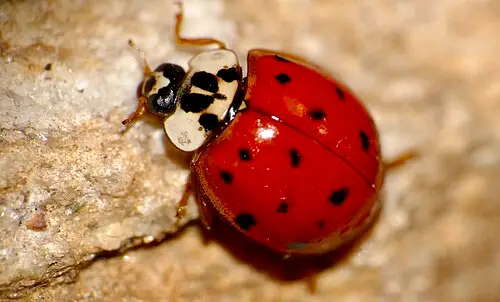
 📸 Photo
Photo: Bernard DUPONT from FRANCE · CC BY-SA 2.0 · Wikimedia Commons Source
Asian lady beetle
Harmonia axyridis (Asian lady beetle · ナミテントウ)
Not Evaluated (NE) on the IUCN Red List yet.
💡 Everyday Comparisons for Size, Mass & Speed
- 💡 Its body length of 8 mm is less than half the size of a Korean 10-won coin (diameter 18 mm) (Comparison).
- 💡 ADW notes that because this ladybird's main prey is aphids, which are major crop pests, it is used in biological control to reduce pest populations.
Reference standards: coach bus ~12 m, mid-size car ~4.9 m, compact car ~1 t, basketball hoop 3.05 m, credit card 8.56 cm.
📖 1. Overview
The Asian lady beetle is the most common ladybird species in Korea and a very beneficial insect that feeds on aphids. It is also distributed in Japan, China, Taiwan, and Russia.
🦴 2. Anatomy & Morphology
It has a round body 5–8 mm long, mostly orange or vermilion though black individuals also occur. Its dorsal pattern varies greatly, including individuals with or without black spots and individuals with large spots over a black background.
🔍 3. Ecology & Behavior
It preys mainly on aphids and scale insects and appears from May to November. Adults overwinter in groups, and according to ADW, when food is scarce they also eat the eggs and larvae of other ladybirds.
🇰🇷 4. Connection to Korea
The National List of Species of Korea notes that it inhabits all of Korea and is the most common ladybird species in the country.
📚 Sources & References
- • IUCN Red List: not evaluated (NE) — cross-checked with the Wikidata conservation-status entry
- • checklistbank.org — PNVYQ
- • 국가생물종목록(국립생물자원관) ktsn 120000015942 — https://species.nibr.go.kr/home/mainHome.do?cont_link=009&subMenu=009002&contCd=009002&ktsn=120000015942
- • wikidata.org — Q499627
- • species.nibr.go.kr — mainHome.do
- • animaldiversity.org — Harmonia axyridis
- • Silhouette: PhyloPic — Amy Beauvois · CC0 1.0 (Related taxon silhouette — Coccinella)
Recorded dimensions are widely cited representative estimates from public literature and may vary by study or specimen.