 📸 Photo
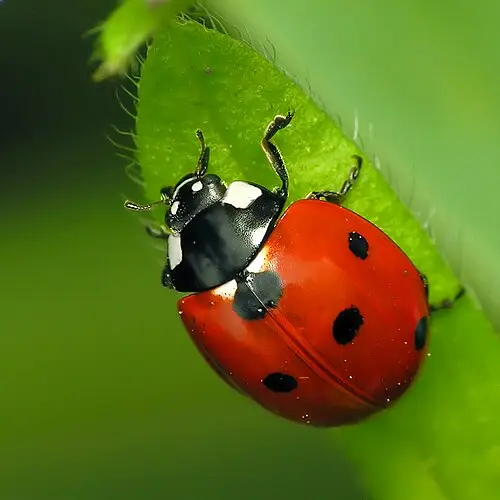
Photo: Photographer: Dominik Stodulski Graphic Processing: User:MathKnight · CC BY-SA 3.0 · Wikimedia Commons Source
Seven-spot ladybird
Coccinella septempunctata (Seven-spot ladybird · ナナホシテントウ)
Not Evaluated (NE) on the IUCN Red List yet.
💡 Everyday Comparisons for Size, Mass & Speed
- 💡 Commonly seen on plants in kitchen gardens or flowerbeds where aphids have appeared, it is introduced in Rural Development Administration materials as a natural enemy that controls pests and reduces pesticide use.
- 💡 Its maximum body length of 7.8 mm is less than half the diameter of a Korean 10-won coin (18 mm) (Comparison).
Reference standards: coach bus ~12 m, mid-size car ~4.9 m, compact car ~1 t, basketball hoop 3.05 m, credit card 8.56 cm.
📖 1. Overview
The seven-spot ladybird is a representative aphid-eating ladybird with seven black spots on its red back.
🦴 2. Anatomy & Morphology
Its body is round and convex, usually with seven black spots on orange-red elytra and white spots on both front sides of the pronotum. When threatened, it secretes a toxic substance from its leg joints to drive off predators.
🔍 3. Ecology & Behavior
It mainly preys on aphids, and when prey is scarce, adults also eat pollen. A female lays about 200–1,000 eggs in a season, and a single larva eats about 4,000 aphids while growing.
🇰🇷 4. Connection to Korea
It lives widely across northern, central, and southern Korea as well as Jeju Island and Ulleungdo, producing 2 or more generations a year and appearing from April to November. It preys on aphids in low grasslands of fields, forest edges, villages, and streambanks.
📚 Sources & References
- • IUCN Red List: not evaluated (NE) — cross-checked with the Wikidata conservation-status entry
- • checklistbank.org — N2HSP
- • 국가생물종목록(국립생물자원관) ktsn 120000015919 — https://species.nibr.go.kr/home/mainHome.do?cont_link=009&subMenu=009002&contCd=009002&ktsn=120000015919
- • wikidata.org — Q159543
- • commons.wikimedia.org — File:7-Spotted-Ladybug-Coccinella-septempunctata-sq1.jpg
- • animaldiversity.org — Coccinella septempunctata
- • genebank.rda.go.kr — cyberView.bo
- • biocontrol.entomology.cornell.edu — Coccinella.php
- • bok.or.kr — contents.do
- • Silhouette: PhyloPic — Amy Beauvois · CC0 1.0 (Congeneric silhouette — Coccinella)
Recorded dimensions are widely cited representative estimates from public literature and may vary by study or specimen.