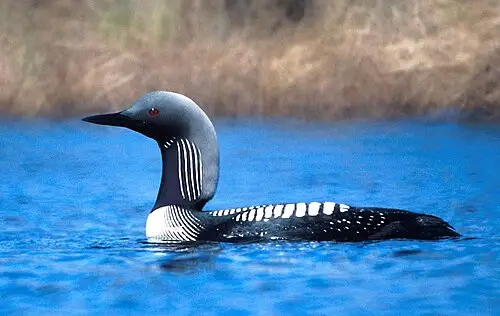
 📸 Photo
Photo: Tim Bowman, USFWS Originally uploaded by User Kingturtle on en.wikipedia · Public domain · Wikimedia Commons Source
Pacific Loon
Gavia pacifica (Pacific Loon · シロエリオオハム)
💡 Everyday Comparisons for Size, Mass & Speed
- 💡 Its body length of about 69 cm is slightly shorter than a full-length umbrella (about 80–90 cm) (Comparison).
- 💡 In winter off Geojedo Island on the southern coast of Korea, it can be seen singly, in pairs, or in flocks of dozens of birds (National List of Species of Korea).
- 💡 Chicks ride on their parents' backs to conserve body heat and avoid predators (Animal Diversity Web).
Reference standards: coach bus ~12 m, mid-size car ~4.9 m, compact car ~1 t, basketball hoop 3.05 m, credit card 8.56 cm.
📖 1. Overview
The Pacific Loon is a large waterbird in the loon family measuring about 69 cm in body length. It breeds in northeastern Siberia and across the North American continent.
🦴 2. Anatomy & Morphology
In summer plumage, it is mouse-gray from the head to the hindneck and has several thick white horizontal bars on the back. Its streamlined body makes it a skilled diver and swimmer.
🔍 3. Ecology & Behavior
It mainly eats fish, crustaceans, mollusks, and echinoderms. When wary, it submerges its body in the water with only its neck exposed, and in June–July it lays about 2 eggs and incubates them for 20 days.
🇰🇷 4. Connection to Korea
In Korea, it is a winter visitor that spends the winter along the southern coast and off Geojedo Island.
📚 Sources & References
- • IUCN Red List LC (2018) — https://www.iucnredlist.org/species/22697839/132607134
- • IUCN Red List category LC — latest assessment at iucnredlist.org
- • doi.org — avilist.v2026
- • iucnredlist.org — 132607134
- • 국가생물종목록(국립생물자원관) ktsn 120000001480 — https://species.nibr.go.kr/home/mainHome.do?cont_link=009&subMenu=009002&contCd=009002&ktsn=120000001480
- • wikidata.org — Q558990
- • commons.wikimedia.org — File:PacificLoon24.jpg
- • species.nibr.go.kr — mainHome.do
- • animaldiversity.org — Gavia pacifica
- • Silhouette: PhyloPic — Andy Wilson · CC0 1.0 (Congeneric silhouette — Gavia stellata)
Recorded dimensions are widely cited representative estimates from public literature and may vary by study or specimen.