 📸 Photo
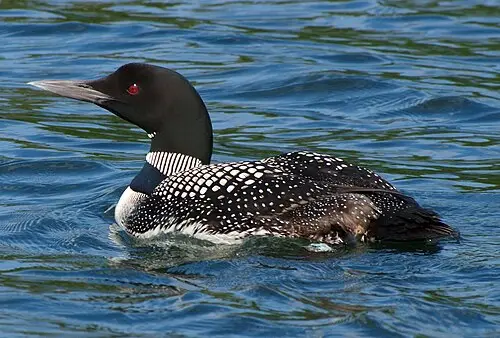
Photo: John Picken from Chicago, USA · CC BY 2.0 · Wikimedia Commons Source
Common Loon
Gavia immer (Common Loon · ハシグロアビ)
💡 Everyday Comparisons for Size, Mass & Speed
- 💡 Its maximum weight of 8 kg is lighter than a 10 kg bag of rice (Comparison).
- 💡 Males give a loud yodeling call to signal that a territory is already occupied (Animal Diversity Web).
- 💡 It was a food source for the Cree Indigenous people of Canada and was once hunted for sport, but is now regarded as a symbol of wilderness (Animal Diversity Web).
Reference standards: coach bus ~12 m, mid-size car ~4.9 m, compact car ~1 t, basketball hoop 3.05 m, credit card 8.56 cm.
Site-computed relative index from recorded values; not a formal scientific metric.
📖 1. Overview
The Common Loon is a large waterbird with a long body that sits low in the water. It breeds on lakes and moves to coastal seas in winter.
🦴 2. Anatomy & Morphology
It has a straight, thick, dagger-like bill; during the breeding season its bill and head are black and its neck has a black-and-white striped collar. In winter, its head and back are evenly gray.
🔍 3. Ecology & Behavior
It locates fish, crayfish, and shrimp by sight and dives 2–4 m deep to catch them. It breeds once a year and is thought to stay with the same mate for life.
🇰🇷 4. Connection to Korea
No direct record connecting this species to Korea has been found.
📚 Sources & References
- • IUCN Red List LC (2018) — https://www.iucnredlist.org/species/22697842/132607418
- • IUCN Red List category LC — latest assessment at iucnredlist.org
- • doi.org — avilist.v2026
- • iucnredlist.org — 132607418
- • wikidata.org — Q190342
- • commons.wikimedia.org — File:Gavia immer -Minocqua, Wisconsin, USA -swimming-8.jpg
- • animaldiversity.org — Gavia immer
- • Silhouette: PhyloPic — Unknown (photo), John E. McCormack, Michael G. Harvey, Brant C. Faircloth, Nicholas G. Crawford, Travis C. Glenn, Robb T. Brumfield & T. Michael Keesey · CC BY 3.0
Recorded dimensions are widely cited representative estimates from public literature and may vary by study or specimen.