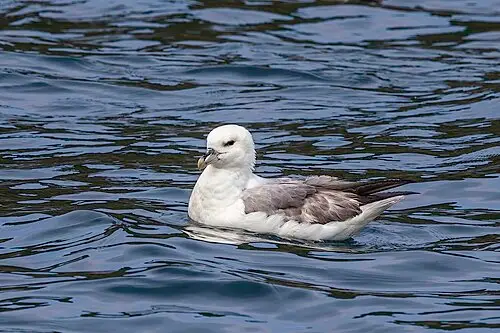
 📸 Photo
Photo: Charles J. Sharp · CC BY-SA 4.0 · Wikimedia Commons Source
Northern Fulmar
Fulmarus glacialis (Northern Fulmar · フルマカモメ)
💡 Everyday Comparisons for Size, Mass & Speed
- 💡 Its maximum weight of 1 kg is the weight of one 1 kg bag of sugar (Comparison).
- 💡 It follows fishing vessels in large flocks to feed on discarded fish offal (Animal Diversity Web).
- 💡 In the past, people also harvested these birds for food at their breeding colonies (Animal Diversity Web).
Reference standards: coach bus ~12 m, mid-size car ~4.9 m, compact car ~1 t, basketball hoop 3.05 m, credit card 8.56 cm.
Site-computed relative index from recorded values; not a formal scientific metric.
📖 1. Overview
The Northern Fulmar is a seabird living in waters over continental shelves from the Arctic pack ice edge to temperate seas. During the breeding season, it gathers to nest on rocky cliffs.
🦴 2. Anatomy & Morphology
It has four color morphs ranging from very dark to very light plumage. Unusually among birds, it has a keen sense of smell and is thought to use olfaction to find food.
🔍 3. Ecology & Behavior
It eats fish, squid, and large zooplankton, and also feeds on carrion such as whale and seal blubber. Unless its mate dies, it returns to the same nest site each year to breed.
🇰🇷 4. Connection to Korea
No direct record connecting this species to Korea has been found.
📚 Sources & References
- • IUCN Red List LC (2018) — https://www.iucnredlist.org/species/22697866/132609419
- • IUCN Red List category LC — latest assessment at iucnredlist.org
- • doi.org — avilist.v2026
- • iucnredlist.org — 132609419
- • wikidata.org — Q26896
- • commons.wikimedia.org — File:Fulmar (Fulmarus glacialis) on water.jpg
- • animaldiversity.org — Fulmarus glacialis
- • Silhouette: PhyloPic — Edwin Price · CC0 1.0 (Congeneric silhouette — Fulmarus glacialoides)
Recorded dimensions are widely cited representative estimates from public literature and may vary by study or specimen.