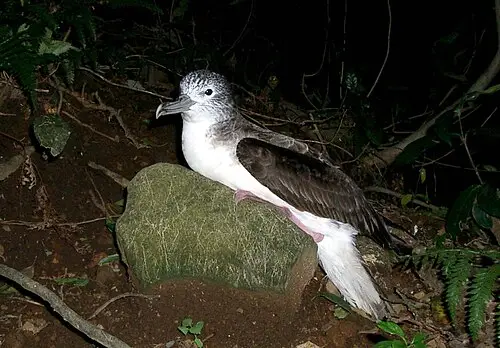
 📸 Photo
Photo: Kanachoro · CC BY-SA 3.0 · Wikimedia Commons Source
Streaked Shearwater
Calonectris leucomelas (Streaked Shearwater · オオミズナギドリ)
💡 Everyday Comparisons for Size, Mass & Speed
- 💡 Because its wings are long, it cannot take off from level ground and instead leaps from trees or cliffs or runs to become airborne (National List of Species of Korea).
- 💡 Ulleungdo and Jeju Island are the main places where it can be seen in Korea (National List of Species of Korea).
- 💡 It is unusual as a seabird that nests and lays its egg inside burrows dug into the ground (National List of Species of Korea).
Reference standards: coach bus ~12 m, mid-size car ~4.9 m, compact car ~1 t, basketball hoop 3.05 m, credit card 8.56 cm.
📖 1. Overview
The streaked shearwater is a seabird that lives in flocks at sea and is a summer visitor that rarely breeds in Korea. Globally, it is distributed along the coasts of China and neighboring waters.
🦴 2. Anatomy & Morphology
Males and females look similar, with dark brown feathers tipped in white from the forehead to the back of the head. Because its wings are long, it cannot take off directly from flat ground.
🔍 3. Ecology & Behavior
It eats fish, squid, octopus, and marine algae. It digs burrows in the ground for nests and lays 1 egg in June–July (months 6–7), which both parents take turns incubating.
🇰🇷 4. Connection to Korea
Observed on Ulleungdo and Jeju Island, it is a summer visitor that breeds rarely in Korea.
📚 Sources & References
- • IUCN Red List NT (2018) — https://www.iucnredlist.org/species/22698172/132630766
- • IUCN Red List category NT — latest assessment at iucnredlist.org
- • doi.org — avilist.v2026
- • iucnredlist.org — 132630766
- • 국가생물종목록(국립생물자원관) ktsn 120000001490 — https://species.nibr.go.kr/home/mainHome.do?cont_link=009&subMenu=009002&contCd=009002&ktsn=120000001490
- • wikidata.org — Q181320
- • commons.wikimedia.org — File:Streaked shearwater sitting.jpg
- • species.nibr.go.kr — mainHome.do
- • Silhouette: PhyloPic — Louis Ranjard · CC BY 3.0 (Related taxon silhouette — Pelecanoides urinatrix urinatrix)
Recorded dimensions are widely cited representative estimates from public literature and may vary by study or specimen.