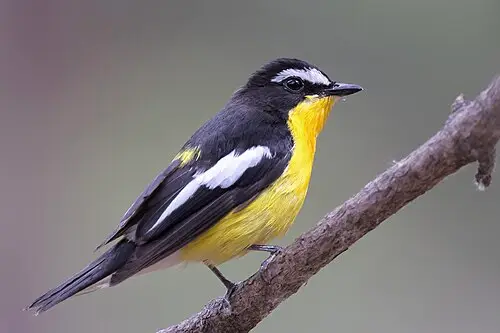
 📸 Photo
Photo: 王朝威 · CC BY 4.0 · Wikimedia Commons Source
Yellow-rumped Flycatcher
Ficedula zanthopygia (Yellow-rumped Flycatcher · マミジロキビタキ)
💡 Everyday Comparisons for Size, Mass & Speed
- 💡 Its body length of 13 cm is slightly shorter than a ballpoint pen (about 14 cm) (Comparison).
- 💡 According to the National List of Species of Korea, it lives in urban parks and gardens and uses artificial nest boxes, so it sometimes uses birdhouses hung in parks.
Reference standards: coach bus ~12 m, mid-size car ~4.9 m, compact car ~1 t, basketball hoop 3.05 m, credit card 8.56 cm.
📖 1. Overview
The Yellow-rumped Flycatcher is an uncommon summer visitor breeding across Korea; males have bright yellow underparts and a white supercilium. In winter, it migrates south to the Malay Peninsula and Sumatra.
🦴 2. Anatomy & Morphology
Its body length is 13 cm. The male has black upperparts, a white supercilium, yellow underparts, and white undertail coverts, while the female has greenish-gray upperparts and pale, nearly white yellow underparts.
🔍 3. Ecology & Behavior
It builds its nest on fir branches, in tree cavities, or in artificial nest boxes, laying 5–6 eggs around May. It preys on insects and spiders.
🇰🇷 4. Connection to Korea
The National List of Species of Korea describes it as an uncommon summer visitor breeding in urban parks, gardens, and lowland or hillside forests nationwide.
📚 Sources & References
- • IUCN Red List LC (2025) — https://www.iucnredlist.org/species/22709325/227972217
- • IUCN Red List category LC — latest assessment at iucnredlist.org
- • doi.org — avilist.v2026
- • iucnredlist.org — 227972217
- • 국가생물종목록(국립생물자원관) ktsn 120000002140 — https://species.nibr.go.kr/home/mainHome.do?cont_link=009&subMenu=009002&contCd=009002&ktsn=120000002140
- • wikidata.org — Q73574
- • commons.wikimedia.org — File:Ficedula zanthopygia 220093415.jpg
- • species.nibr.go.kr — mainHome.do
- • Silhouette: PhyloPic — hedera.baltica · CC BY 4.0 (Congeneric silhouette — Ficedula albicollis)
Recorded dimensions are widely cited representative estimates from public literature and may vary by study or specimen.