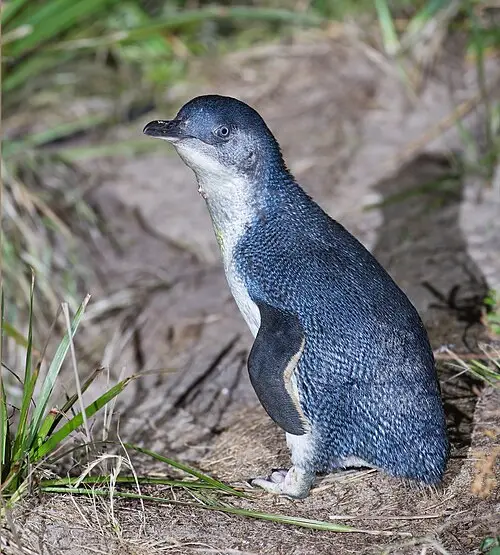
 📸 Photo
Photo: JJ Harrison ( https://www.jjharrison.com.au/ ) · CC BY-SA 3.0 · Wikimedia Commons Source
Little Penguin
Eudyptula minor (Little Penguin · コガタペンギン)
💡 Everyday Comparisons for Size, Mass & Speed
- 💡 Its height of 30 cm is almost the same as the long side of a sheet of A4 paper (29.7 cm) (Comparison).
- 💡 On Phillip Island in Australia, about 500,000 visitors come each year to watch the penguin parade returning from the water to their nests at dusk (Animal Diversity Web).
- 💡 Because of how it withstands the cold despite its small body size, it is studied in research on thermoregulation in warm-blooded animals (Animal Diversity Web).
Reference standards: coach bus ~12 m, mid-size car ~4.9 m, compact car ~1 t, basketball hoop 3.05 m, credit card 8.56 cm.
Site-computed relative index from recorded values; not a formal scientific metric.
📖 1. Overview
The Little Penguin is the smallest penguin in the world and spends most of its life underwater at sea. It breeds in burrows dug in coastal sand or in rock crevices.
🦴 2. Anatomy & Morphology
Its head and back are indigo-blue while its chin, throat, and belly are white, and its black bill is about 35 mm long. Eye color varies from silver to blue, gray, and hazel.
🔍 3. Ecology & Behavior
It mainly catches Clupeiformes fish such as sardines and anchovies, and also eats small squid, octopuses, and crustaceans. Recently, declining prey numbers have forced it to make longer foraging trips.
🇰🇷 4. Connection to Korea
No direct record connecting this species to Korea has been found.
📚 Sources & References
- • IUCN Red List LC (2020) — https://www.iucnredlist.org/species/22697805/202126091
- • IUCN Red List category LC — latest assessment at iucnredlist.org
- • doi.org — avilist.v2026
- • iucnredlist.org — 202126091
- • wikidata.org — Q203628
- • commons.wikimedia.org — File:Eudyptula minor Bruny 1.jpg
- • animaldiversity.org — Eudyptula minor
- • Silhouette: PhyloPic — Fir0002/Flagstaffotos (photo), John E. McCormack, Michael G. Harvey, Brant C. Faircloth, Nicholas G. Crawford, Travis C. Glenn, Robb T. Brumfield & T. Michael Keesey · CC BY 3.0
Recorded dimensions are widely cited representative estimates from public literature and may vary by study or specimen.