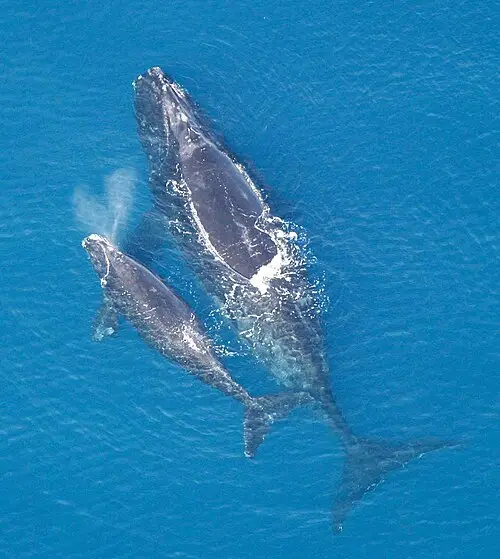
 📸 Photo
Photo: Public domain · Public domain · Wikimedia Commons Source
North Atlantic Right Whale
Eubalaena glacialis (North Atlantic Right Whale · タイセイヨウセミクジラ)
💡 Everyday Comparisons for Size, Mass & Speed
- 💡 Its maximum body length of 17 m is about 1.4 times the length of a city bus (about 12 m) (Comparison).
- 💡 Hunted since at least 1,000 years ago for oil (for lamps) and meat, it now generates revenue mainly through whale-watching tourism.
Reference standards: coach bus ~12 m, mid-size car ~4.9 m, compact car ~1 t, basketball hoop 3.05 m, credit card 8.56 cm.
Site-computed relative index from recorded values; not a formal scientific metric.
📖 1. Overview
The North Atlantic Right Whale is a stocky baleen whale living along the western coast of the North Atlantic, assessed as Critically Endangered (CR) due to its very small population.
🦴 2. Anatomy & Morphology
It lacks a dorsal fin and has broad, short flippers. Its body is mostly black, with white callosities—rough patches of skin inhabited by whale lice—around its head and jaws.
🔍 3. Ecology & Behavior
Swimming near the surface with its mouth open, it filters small copepods and krill through its baleen plates. It usually travels in groups of one to twelve individuals, commonly around two, and migrates to warmer waters in winter to give birth.
🇰🇷 4. Connection to Korea
No direct record connecting this species to Korea has been found.
📚 Sources & References
- • IUCN Red List CR (2020) — https://www.iucnredlist.org/species/41712/178589687
- • IUCN Red List category CR — latest assessment at iucnredlist.org
- • mammaldiversity.org — 1006395
- • iucnredlist.org — 178589687
- • wikidata.org — Q193683
- • commons.wikimedia.org — File:Eubalaena glacialis with calf.jpg
- • animaldiversity.org — Eubalaena glacialis
- • fisheries.noaa.gov — north-atlantic-right-whale
- • Silhouette: PhyloPic — author not recorded · Public Domain Mark 1.0 (Congeneric silhouette — Eubalaena japonica)
Recorded dimensions are widely cited representative estimates from public literature and may vary by study or specimen.