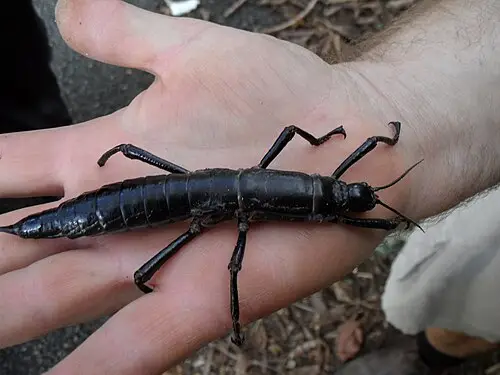
 📸 Photo
Photo: Granitethighs · CC BY-SA 3.0 · Wikimedia Commons Source
Lord Howe Island stick insect
Dryococelus australis (Lord Howe Island stick insect · ロードハウナナフシ)
💡 Everyday Comparisons for Size, Mass & Speed
- 💡 The female body length of 12 cm is slightly more than half the short side of an A4 sheet of paper (21 cm) (Comparison).
- 💡 In materials from the New South Wales Government of Australia, introduced rats brought to the island are listed first among the threats that wiped this insect out on the main island—an example of how a single newly introduced animal can eliminate an island's insect.
- 💡 According to Australian government materials, Melbourne Zoo established a captive breeding program to increase numbers and return the species to the main island.
Reference standards: coach bus ~12 m, mid-size car ~4.9 m, compact car ~1 t, basketball hoop 3.05 m, credit card 8.56 cm.
📖 1. Overview
The Lord Howe Island stick insect is a large, wingless stick insect endemic to Australia's Lord Howe Island group. After disappearing from the main island due to predation by introduced rats, it now survives only in a tiny habitat on Ball's Pyramid and was assessed as Critically Endangered (CR, 2017) by the IUCN.
🦴 2. Anatomy & Morphology
Its body is large, heavy, and flightless. Females reach up to 12 cm in body length and males 10.6 cm; adults are dark golden-brown with a cream stripe along the abdomen, while juveniles are bright green.
🔍 3. Ecology & Behavior
It hides during the day in wet leaf litter or tree hollows and comes out at night to eat shrub leaves. On Ball's Pyramid, it has been observed nibbling the tips of new leaves on a single shrub species, Melaleuca.
🇰🇷 4. Connection to Korea
No direct record connecting this species to Korea has been found.
📚 Sources & References
- • IUCN Red List CR (2017) — https://www.iucnredlist.org/species/6852
- • IUCN Red List category CR — latest assessment at iucnredlist.org
- • catalogueoflife.org — 37V74
- • iucnredlist.org — 6852
- • wikidata.org — Q152856
- • commons.wikimedia.org — File:Lord Howe Island stick insect Dryococelus australis 10J
- • environment.gov.au — publicspecies.pl
- • threatenedspecies.bionet.nsw.gov.au — profile
- • Silhouette: PhyloPic — Christoph Schomburg · CC0 1.0 (Related taxon silhouette — Medauroidea extradentata)
Recorded dimensions are widely cited representative estimates from public literature and may vary by study or specimen.