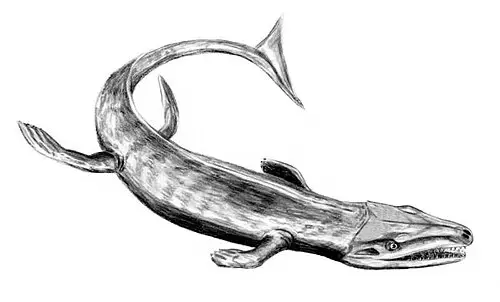
 🎨 Restoration
Restoration: User:ArthurWeasley · CC BY 2.5 · Wikimedia Commons Source
Life restorations are artistic reconstructions based on fossil evidence; true coloration and soft-tissue details remain uncertain.
Dakosaurus
Dakosaurus maximus (Dakosaurus · Dakosaurus)
Known only from fossils. The IUCN Red List assesses only species extant since 1500 CE, so fossil taxa are not assigned a category.
💡 Everyday Comparisons for Size, Mass & Speed
- 💡 An estimated body length of 4.49 m is nearly the same as the length of a single mid-size passenger car (about 4.5 m) (Comparison).
- 💡 The 87.5 cm lower jawbone of the largest specimen is slightly longer than a baseball bat (about 85 cm) (Comparison).
Reference standards: coach bus ~12 m, mid-size car ~4.9 m, compact car ~1 t, basketball hoop 3.05 m, credit card 8.56 cm.
📖 1. Overview
Dakosaurus maximus (genus Dakosaurus) was a crocodile relative in the family Metriorhynchidae that lived in Late Jurassic seas. Adapted to marine life, this large predator is considered to have been at the top of the food chain.
🦴 2. Anatomy & Morphology
It had a robust skull, a 'lateral plate' on the premaxilla, and distinct ornamentation on the surface of the maxilla. Its teeth were large and bladed, and the upper and lower teeth interlocked tightly.
🔍 3. Fossil Record & Paleoecology
It is studied as an apex predator that caught large prey with its strong skull and powerful bite. The largest specimen is a lower jawbone found in limestone in Painten, Germany.
🇰🇷 4. Connection to Korea
No direct record connecting this species to Korea has been found.
📚 Sources & References
- • Fossil taxon — the IUCN Red List assesses only species living or extinct since 1500
- • paleobiodb.org — basicTaxonInfo
- • wikidata.org — Q20717735
- • commons.wikimedia.org — File:Dakosaurus maximus.JPG
- • pmc.ncbi.nlm.nih.gov — PMC3445579
- • Silhouette: PhyloPic — Dmitry Bogdanov (vectorized by T. Michael Keesey) · CC BY 3.0
Recorded dimensions are widely cited representative estimates from public literature and may vary by study or specimen.