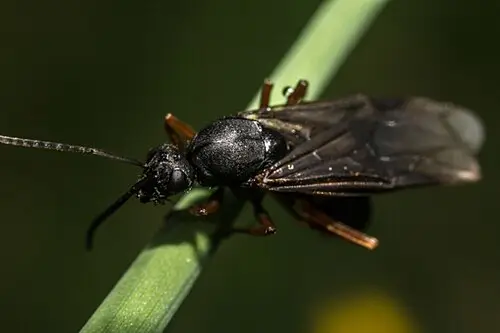
 📸 Photo
Photo: Lennart Tange on Flickr · CC BY 3.0 · Wikimedia Commons Source
White butterfly parasitoid wasp
Cotesia glomerata (White butterfly parasitoid wasp · アオムシサムライコマユバチ)
Not Evaluated (NE) on the IUCN Red List yet.
💡 Everyday Comparisons for Size, Mass & Speed
- 💡 It is a wasp that reduces caterpillars of the small white that chew on napa cabbage, the main ingredient of kimchi, and has been directly released in highland napa cabbage fields.
- 💡 Its body length of about 7 mm is less than half the diameter of a Korean 10-won coin (18 mm) (Comparison).
Reference standards: coach bus ~12 m, mid-size car ~4.9 m, compact car ~1 t, basketball hoop 3.05 m, credit card 8.56 cm.
📖 1. Overview
The white butterfly parasitoid wasp is a small parasitoid wasp that lays eggs inside caterpillars of the small white, serving as a natural enemy that protects vegetables such as napa cabbage.
🦴 2. Anatomy & Morphology
It is a small black wasp about 7 mm long that looks like a winged ant or small fly, with antennae about 1.5 mm long. At the tip of the female's abdomen, the egg-laying ovipositor curves downward.
🔍 3. Ecology & Behavior
A female lays 20–60 eggs inside a single young butterfly caterpillar, and after 15–20 days the wasp larvae emerge from the host and spin yellow cocoons. It takes 22–30 days from egg to adult, and the host dies once the wasp larvae emerge.
🇰🇷 4. Connection to Korea
The Highland Agriculture Research Institute of the Rural Development Administration released this wasp into highland napa cabbage fields every early August from 2007 to 2018, and the field parasitism rate rose over the years to reach 6.5% in 2018.
📚 Sources & References
- • IUCN Red List: not evaluated (NE) — cross-checked with the Wikidata conservation-status entry
- • catalogueoflife.org — YX8V
- • 국가생물종목록(국립생물자원관) ktsn 120000472690 — https://species.nibr.go.kr/home/mainHome.do?cont_link=009&subMenu=009002&contCd=009002&ktsn=120000472690
- • wikidata.org — Q474464
- • commons.wikimedia.org — File:Cotesia Glomerata.jpg
- • biocontrol.entomology.cornell.edu — cotesia.php
- • koreascience.or.kr — JAKO201908071719102.pub
- • bok.or.kr — contents.do
- • Silhouette: PhyloPic — author not recorded · CC0 1.0 (Related taxon silhouette — Diachasmimorpha longicaudata)
Recorded dimensions are widely cited representative estimates from public literature and may vary by study or specimen.