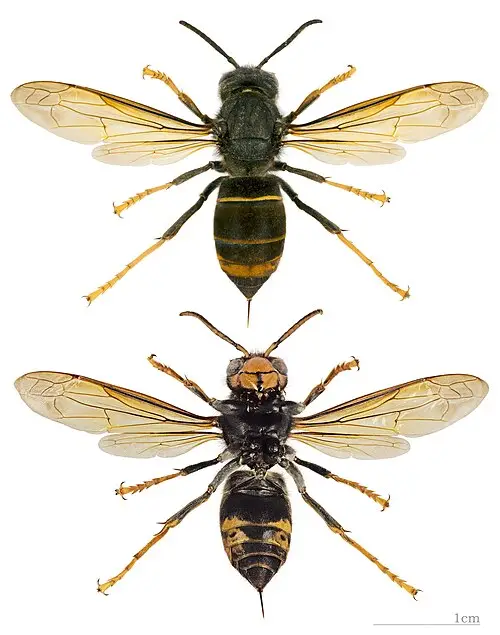
 📸 Photo
Photo: Didier Descouens · CC BY-SA 3.0 · Wikimedia Commons Source
Yellow-legged hornet
Vespa velutina (Yellow-legged hornet · ツマアカスズメバチ)
Not Evaluated (NE) on the IUCN Red List yet.
💡 Everyday Comparisons for Size, Mass & Speed
- 💡 Government guidance advises quickly moving away and calling the fire department if you see a hornet nest or are attacked, and wearing bright clothes rather than dark clothes outdoors.
- 💡 A worker's body length of about 20 mm is slightly longer than the diameter of a Korean 10-won coin (18 mm) (Comparison). Damage to honey bees reduces income for beekeeping farms.
Reference standards: coach bus ~12 m, mid-size car ~4.9 m, compact car ~1 t, basketball hoop 3.05 m, credit card 8.56 cm.
📖 1. Overview
The yellow-legged hornet is an introduced hornet from southern China that preys on honey bees, causing heavy damage to beekeeping, and is managed as an ecosystem-disturbing species in Korea.
🦴 2. Anatomy & Morphology
Body length is about 20 mm in workers, about 24 mm in males, and about 30 mm in queens. Compared with other hornets, it prefers urban areas.
🔍 3. Ecology & Behavior
Honey bees make up more than 85% of its diet, and it raids honey bees, weakening hive strength. Overwintered queens begin solitary activity in April–June, and catching a single queen at this time has the effect of preventing more than 3,000–5,000 hornets.
🇰🇷 4. Connection to Korea
Estimated to have entered through Busan from China in 2003, it has spread by 10–20 km per year and now occurs nationwide. It was designated an ecosystem-disturbing species in 2019 and accounts for more than 40% of urban hornet emergency calls.
📚 Sources & References
- • IUCN Red List: not evaluated (NE) — cross-checked with the Wikidata conservation-status entry
- • catalogueoflife.org — 7G3C6
- • 국가생물종목록(국립생물자원관) ktsn 120000031635 — https://species.nibr.go.kr/home/mainHome.do?cont_link=009&subMenu=009002&contCd=009002&ktsn=120000031635
- • wikidata.org — Q136668
- • commons.wikimedia.org — File:Vespa velutina nigrithorax MHNT.jpg
- • korea.kr — policyNewsView.do
- • rda.go.kr — board.do
- • bok.or.kr — contents.do
- • Silhouette: PhyloPic — author not recorded · CC0 1.0 (Congeneric silhouette — Vespa crabro)
Recorded dimensions are widely cited representative estimates from public literature and may vary by study or specimen.