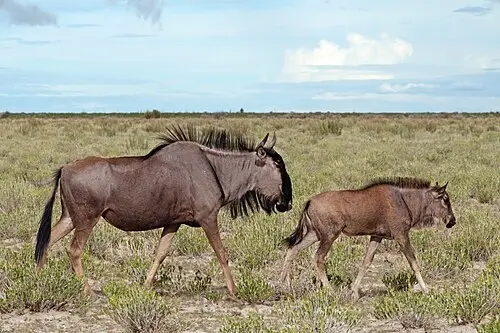
 📸 Photo
Photo: Charles J. Sharp · CC BY-SA 4.0 · Wikimedia Commons Source
Blue Wildebeest
Connochaetes taurinus (Blue Wildebeest · オグロヌー)
💡 Everyday Comparisons for Size, Mass & Speed
- 💡 Its large herds are a major attraction for safari tourism, creating jobs and bringing in foreign investment (Animal Diversity Web).
- 💡 A body weight of 270 kg is equal to 13–14 bags of 20 kg rice (Comparison).
- 💡 Driven by water needs, herds leave their grazing grounds and move up to 50 km to find better pasture (Animal Diversity Web).
Reference standards: coach bus ~12 m, mid-size car ~4.9 m, compact car ~1 t, basketball hoop 3.05 m, credit card 8.56 cm.
Site-computed relative index from recorded values; not a formal scientific metric.
📖 1. Overview
The Blue Wildebeest is a bovid living on the African savanna, famous for large herds of thousands that travel hundreds of km in search of food.
🦴 2. Anatomy & Morphology
It has broad shoulders, cow-like horns, and a wide muzzle, with a slate-gray body marked by dark vertical stripes on the shoulders and back. It also has a mane and a beard.
🔍 3. Ecology & Behavior
A herbivore that feeds on rapidly growing grass, it grazes during the day and on moonlit nights. When food and water dwindle, thousands of individuals migrate hundreds of km.
🇰🇷 4. Connection to Korea
No direct record connecting this species to Korea has been found.
📚 Sources & References
- • IUCN Red List LC (2016) — https://www.iucnredlist.org/species/5229/163322525
- • IUCN Red List category LC — latest assessment at iucnredlist.org
- • mammaldiversity.org — 1006134
- • iucnredlist.org — 163322525
- • wikidata.org — Q328809
- • commons.wikimedia.org — File:Blue wildebeest (Connochaetes taurinus taurinus) female
- • animaldiversity.org — Connochaetes taurinus
- • Silhouette: PhyloPic — Graham Montgomery · CC BY 4.0
Recorded dimensions are widely cited representative estimates from public literature and may vary by study or specimen.