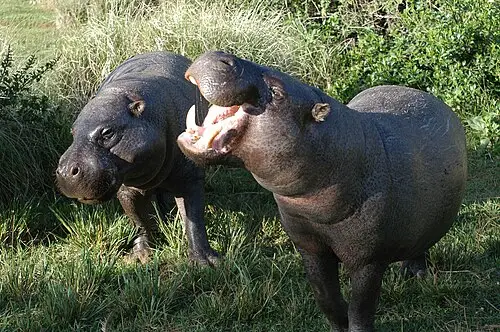
 📸 Photo
Photo: Chuckupd · Public domain · Wikimedia Commons Source
Pygmy Hippopotamus
Choeropsis liberiensis (Pygmy Hippopotamus · コビトカバ)
💡 Everyday Comparisons for Size, Mass & Speed
- 💡 Captive individuals have been confirmed to breed year-round, and one lived up to 43 years in captivity.
- 💡 In West Africa, hunting for bushmeat is a major threat to this species.
- 💡 Its maximum weight of 275 kg is roughly equal to fourteen 20 kg bags of rice (Comparison).
Reference standards: coach bus ~12 m, mid-size car ~4.9 m, compact car ~1 t, basketball hoop 3.05 m, credit card 8.56 cm.
Site-computed relative index from recorded values; not a formal scientific metric.
📖 1. Overview
A small hippopotamus that lives near water in West African forests and is active alone at night.
🦴 2. Anatomy & Morphology
Its skin is dark brown and secretes a reddish substance known as 'blood sweat,' and it has a forward-sloping back and eyes set on the sides of its head. Its canines grow continuously.
🔍 3. Ecology & Behavior
It feeds on leaves, roots, tubers, and fallen fruits. The gestation period is 184 to 210 days, and females usually give birth to a single calf.
🇰🇷 4. Connection to Korea
No direct record connecting this species to Korea has been found.
📚 Sources & References
- • IUCN Red List EN (2015) — https://www.iucnredlist.org/species/10032/18567171
- • IUCN Red List category EN — latest assessment at iucnredlist.org
- • mammaldiversity.org — 1006389
- • iucnredlist.org — 18567171
- • wikidata.org — Q22110899
- • commons.wikimedia.org — File:Pygmy hippopotamus pair.jpg
- • animaldiversity.org — Hexaprotodon liberiensis
- • Silhouette: PhyloPic — T. Michael Keesey (after Marek Velechovský) · CC BY 3.0
Recorded dimensions are widely cited representative estimates from public literature and may vary by study or specimen.