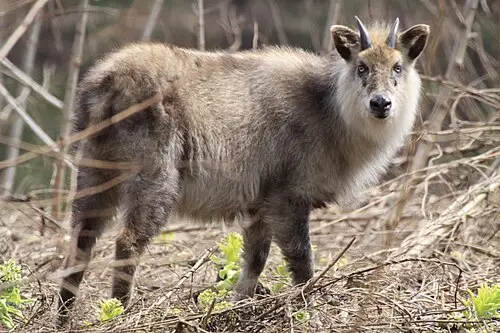
 📸 Photo
Photo: Kei hashi · CC BY-SA 3.0 · Wikimedia Commons Source
Japanese Serow
Capricornis crispus (Japanese Serow · ニホンカモシカ)
💡 Everyday Comparisons for Size, Mass & Speed
- 💡 Once an important game animal hunted for meat and hides, it is now recognized as a natural heritage species endemic to Japan (Animal Diversity Web).
- 💡 Its average weight of 37 kg is just under two 20 kg bags of rice (Comparison).
- 💡 Its body length of 1.3 m is close to one-third (1/3) the length of a passenger car (about 4.5 m) (Comparison).
Reference standards: coach bus ~12 m, mid-size car ~4.9 m, compact car ~1 t, basketball hoop 3.05 m, credit card 8.56 cm.
Site-computed relative index from recorded values; not a formal scientific metric.
📖 1. Overview
The Japanese serow is a goat-like species endemic to Japan that lives solitarily and defends territories in mountain forests.
🦴 2. Anatomy & Morphology
Its coat is dark brown, becoming paler in northern populations. Its horns measure 12–16 cm, and it marks its territory with large scent glands in front of its eyes.
🔍 3. Ecology & Behavior
It feeds mainly on buds and leaves of deciduous broadleaf trees, and also eats acorns and fruits. Usually living in pairs, it holds a territory of about 105–166 square kilometers.
🇰🇷 4. Connection to Korea
No direct record connecting this species to Korea has been found.
📚 Sources & References
- • IUCN Red List LC (2020) — https://www.iucnredlist.org/species/3811/22151909
- • IUCN Red List category LC — latest assessment at iucnredlist.org
- • mammaldiversity.org — 1006190
- • iucnredlist.org — 22151909
- • wikidata.org — Q754034
- • commons.wikimedia.org — File:Nihonkamoshika-akita.JPG
- • animaldiversity.org — Capricornis crispus
- • Silhouette: PhyloPic — Gabriela Palomo-Munoz · CC BY 4.0 (Related taxon silhouette — Bos primigenius taurus)
Recorded dimensions are widely cited representative estimates from public literature and may vary by study or specimen.