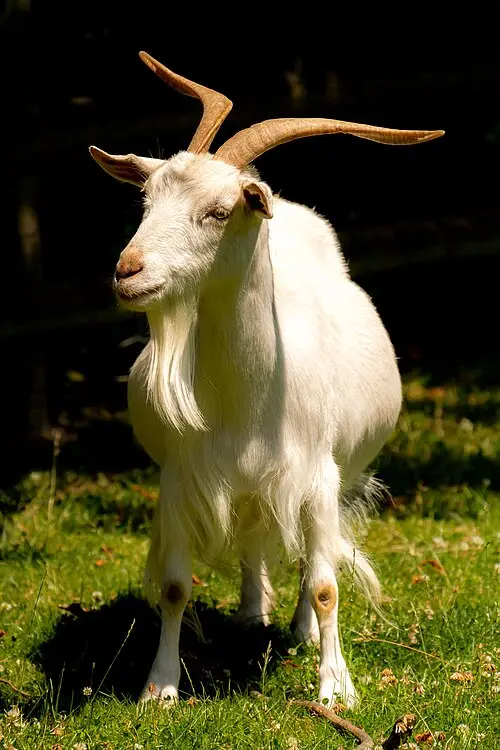
 📸 Photo
Photo: Michael Palmer · CC BY-SA 4.0 · Wikimedia Commons Source
Domestic Goat
Capra hircus (Domestic Goat · Domestic Goat)
Not Evaluated (NE) on the IUCN Red List yet.
💡 Everyday Comparisons for Size, Mass & Speed
- 💡 Goats are raised for milk, cheese, meat, leather, and fiber, and more people worldwide use goats for milk and meat than use cattle (Animal Diversity Web).
- 💡 Goat milk is easier for humans to digest than cow milk, and many people also keep goats as pets or show them at fairs (Animal Diversity Web).
- 💡 The smallest adult dwarf goats weigh 9.1 kg, about half of a 20 kg bag of rice (Comparison).
Reference standards: coach bus ~12 m, mid-size car ~4.9 m, compact car ~1 t, basketball hoop 3.05 m, credit card 8.56 cm.
Site-computed relative index from recorded values; not a formal scientific metric.
📖 1. Overview
The domestic goat is one of the earliest domesticated livestock species alongside sheep, with over 200 breeds raised for milk, meat, and fiber. It thrives even on sparse, coarse vegetation that cattle cannot eat.
🦴 2. Anatomy & Morphology
Males have a chin beard, horns, and a larger build. The hollow horns curve like a scimitar or twist like a corkscrew, though hornless breeds also exist.
🔍 3. Ecology & Behavior
A ruminant with a four-chambered stomach, it feeds on grasses and shrubs. It lives in herds, where males butt heads to establish dominance.
🇰🇷 4. Connection to Korea
No direct record connecting this species to Korea has been found.
📚 Sources & References
- • IUCN Red List: not evaluated (NE) — cross-checked with the Wikidata conservation-status entry
- • mammaldiversity.org — 1006184
- • wikidata.org — Q45320358
- • commons.wikimedia.org — File:A white irish goat.jpg
- • animaldiversity.org — Capra hircus
- • nationalzoo.si.edu — domestic-goat
- • Silhouette: PhyloPic — Steven Traver · CC0 1.0
Recorded dimensions are widely cited representative estimates from public literature and may vary by study or specimen.