 📸 Photo
Photo: Udo Schmidt · CC BY-SA 2.0 · Wikimedia Commons Source
Chinese bean weevil
Callosobruchus chinensis (Chinese bean weevil · Chinese bean weevil)
Not Evaluated (NE) on the IUCN Red List yet.
💡 Everyday Comparisons for Size, Mass & Speed
- 💡 Its body length of 3 mm is one-eighth the diameter of a Korean 100-won coin (24 mm) (Comparison).
- 💡 A paper in the Korean Journal of Applied Entomology reports that adzuki beans fed on by this weevil (damaged seeds) had a 0% germination rate.
Reference standards: coach bus ~12 m, mid-size car ~4.9 m, compact car ~1 t, basketball hoop 3.05 m, credit card 8.56 cm.
📖 1. Overview
The Chinese bean weevil is a small weevil in the subfamily Bruchinae that infests harvested adzuki beans as a stored-grain pest and is distributed worldwide.
🦴 2. Anatomy & Morphology
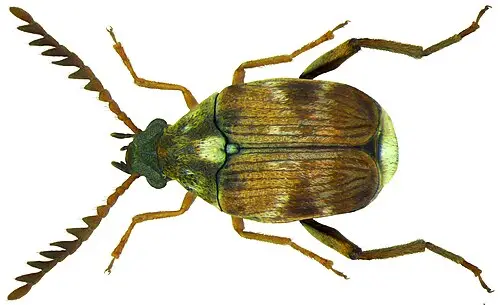
It is a small weevil 2–3 mm long with a broad rear end and a flattened back. Its back is usually reddish-brown with a white spot in the center of the pronotum, and the male has comb-shaped antennae.
🔍 3. Ecology & Behavior
It lives parasitically inside harvested adzuki beans. In a Korean study, it produced 4 generations a year at room temperature, overwintered as a larva inside seeds, preferred adzuki beans most, and took an average of 29 days to emerge from adzuki beans.
🇰🇷 4. Connection to Korea
It is listed as 'Pat-ba-gu-mi' (Korean name) on the National List of Species of Korea, and materials from the Rural Development Administration record its domestic distribution as nationwide.
📚 Sources & References
- • IUCN Red List: not evaluated (NE) — cross-checked with the Wikidata conservation-status entry
- • checklistbank.org — MDDLF
- • 국가생물종목록(국립생물자원관) ktsn 120000015323 — https://species.nibr.go.kr/home/mainHome.do?cont_link=009&subMenu=009002&contCd=009002&ktsn=120000015323
- • wikidata.org — Q14950867
- • commons.wikimedia.org — File:Callosobruchus chinensis (Linné, 1758) male.jpg
- • genebank.rda.go.kr — insectView.bo
- • db.koreascholar.com — 9233
- • Silhouette: PhyloPic — Andy Wilson · CC0 1.0 (Related taxon silhouette — Chrysochus auratus)
Recorded dimensions are widely cited representative estimates from public literature and may vary by study or specimen.