 📸 Photo
Photo: No machine-readable author provided. Iwatebud assumed (based on copyright claims). · CC BY 2.5 · Wikimedia Commons Source
Citrus longhorn beetle
Anoplophora chinensis (Citrus longhorn beetle · Citrus longhorn beetle)
Not Evaluated (NE) on the IUCN Red List yet.
💡 Everyday Comparisons for Size, Mass & Speed
- 💡 A female's body length of 38 mm is about 1.6 times the diameter of a Korean 100-won coin (24 mm) (Comparison).
- 💡 CDFA notes that in 2001 this beetle was found on bonsai maple trees imported from Korea at a nursery in Washington State, USA, prompting an eradication program.
Reference standards: coach bus ~12 m, mid-size car ~4.9 m, compact car ~1 t, basketball hoop 3.05 m, credit card 8.56 cm.
📖 1. Overview
The citrus longhorn beetle is a longhorn beetle native to Asia that damages over 100 species of trees, including citrus, earning it the English name citrus long-horned beetle.
🦴 2. Anatomy & Morphology
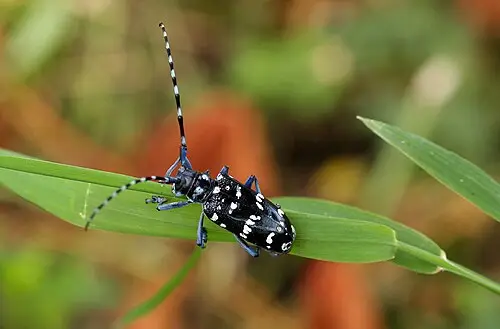
Its glossy black body is scattered with white to pale yellow spots, and the base of each segment of its long antennae is white or pale blue. Females measure about 38 mm, males about 25 mm, and the male's antennae are twice the length of its body.
🔍 3. Ecology & Behavior
Eggs are laid in crevices of trunks or exposed roots, and larvae bore between the phloem and xylem of trunks and roots. Its life cycle usually takes 1 year, and after emerging, adults feed on leaves and tender twig bark for 10–15 days before mating.
🇰🇷 4. Connection to Korea
It is listed on the National List of Species of Korea, and Rural Development Administration materials record its domestic distribution as nationwide and note that adults can be seen on willow trunks from late spring to autumn (under the name Anoplophora malasiaca).
📚 Sources & References
- • IUCN Red List: not evaluated (NE) — cross-checked with the Wikidata conservation-status entry
- • catalogueoflife.org — 678KF
- • 국가생물종목록(국립생물자원관) ktsn 120000019005 — https://species.nibr.go.kr/home/mainHome.do?cont_link=009&subMenu=009002&contCd=009002&ktsn=120000019005
- • wikidata.org — Q206551
- • cdfa.ca.gov — clhb.html
- • genebank.rda.go.kr — insectView.bo
- • Silhouette: PhyloPic — Melissa Broussard · CC BY 3.0 (Related taxon silhouette — Cerambycidae)
Recorded dimensions are widely cited representative estimates from public literature and may vary by study or specimen.