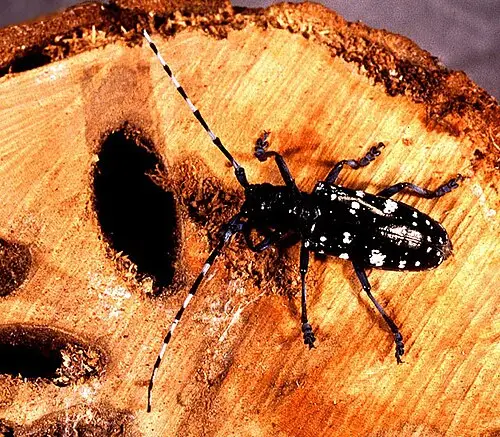
 📸 Photo
Photo: US gov · Public domain · Wikimedia Commons Source
Asian longhorned beetle
Anoplophora glabripennis (Asian longhorned beetle · ツヤハダゴマダラカミキリ)
Not Evaluated (NE) on the IUCN Red List yet.
💡 Everyday Comparisons for Size, Mass & Speed
- 💡 A body length of 33 mm is 6.5 mm longer than a Korean 500-won coin (26.5 mm in diameter) (Comparison).
- 💡 ADW notes that this beetle also lives in urban and suburban environments and in the United States feeds on trees such as birch, chestnut, ash, and maple.
Reference standards: coach bus ~12 m, mid-size car ~4.9 m, compact car ~1 t, basketball hoop 3.05 m, credit card 8.56 cm.
📖 1. Overview
The Asian longhorned beetle is a longhorn beetle living in Gangwon-do, Gyeongsangbuk-do, and Gyeonggi-do whose larvae bore into living maple and willow trees, causing them to wither and die.
🦴 2. Anatomy & Morphology
Adults are 25–33 mm in body length, black and elongated, with white or pale yellow spots scattered on the wing covers. The antennae are about 2 times the body length in males and about 1.3 times in females.
🔍 3. Ecology & Behavior
Adults are diurnal and active from June to August, found on living willows and maples. According to ADW, females lay an average of about 32 eggs one at a time, and adults usually fly within 75 m but can fly up to 1,200 m.
🇰🇷 4. Connection to Korea
The National List of Species of Korea records its distribution in Gangwon-do, Gyeongsangbuk-do, and Gyeonggi-do.
📚 Sources & References
- • IUCN Red List: not evaluated (NE) — cross-checked with the Wikidata conservation-status entry
- • catalogueoflife.org — 66WKJ
- • 국가생물종목록(국립생물자원관) ktsn 120000019006 — https://species.nibr.go.kr/home/mainHome.do?cont_link=009&subMenu=009002&contCd=009002&ktsn=120000019006
- • wikidata.org — Q312378
- • commons.wikimedia.org — File:Asian longhorned beetle.jpg
- • species.nibr.go.kr — mainHome.do
- • animaldiversity.org — Anoplophora glabripennis
- • Silhouette: PhyloPic — Melissa Broussard · CC BY 3.0 (Related taxon silhouette — Cerambycidae)
Recorded dimensions are widely cited representative estimates from public literature and may vary by study or specimen.