 📸 Photo
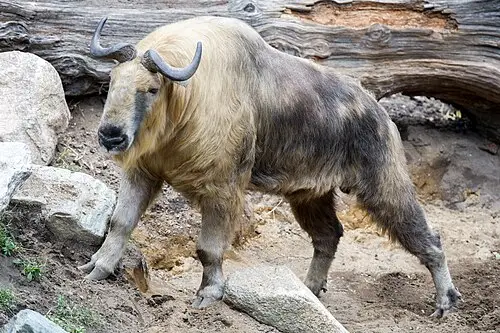
Photo: Eric Kilby from Somerville, MA, USA · CC BY-SA 2.0 · Wikimedia Commons Source
Chinese Takin
Budorcas tibetana (Chinese Takin · Chinese Takin)
Not Evaluated (NE) on the IUCN Red List yet.
💡 Everyday Comparisons for Size, Mass & Speed
- 💡 A male's body length of 2.2 m is nearly half the length of a passenger car (about 4.5 m) (Comparison).
- 💡 Its maximum weight of 400 kg equals twenty 20 kg bags of rice (Comparison).
- 💡 Local people have hunted this animal for meat (Animal Diversity Web).
Reference standards: coach bus ~12 m, mid-size car ~4.9 m, compact car ~1 t, basketball hoop 3.05 m, credit card 8.56 cm.
Site-computed relative index from recorded values; not a formal scientific metric.
📖 1. Overview
The Chinese takin is a member of the takin group—large bovids living in the mountains of the Himalayas and China—moving up and down between high peaks and forested valleys.
🦴 2. Anatomy & Morphology
Its long, shaggy coat ranges from pale yellow to reddish brown with a dark stripe along the back. It has a large head with a broad bare nose, and horns grow up to 64 cm in both sexes.
🔍 3. Ecology & Behavior
A herbivore that feeds mainly on the leaves of deciduous broadleaf trees in the morning and late afternoon, it gathers at high elevations in herds of up to 300 in summer and disperses into groups of around 20 in winter.
🇰🇷 4. Connection to Korea
No direct record connecting this species to Korea has been found.
📚 Sources & References
- • IUCN Red List: not evaluated (NE) — cross-checked with the Wikidata conservation-status entry
- • mammaldiversity.org — 1006681
- • wikidata.org — Q125226250
- • commons.wikimedia.org — File:Takin Standing (22221570730).jpg
- • animaldiversity.org — Budorcas taxicolor
- • Silhouette: PhyloPic — Kai Caspar · CC0 1.0 (Congeneric silhouette — Budorcas taxicolor)
Recorded dimensions are widely cited representative estimates from public literature and may vary by study or specimen.